
Home Choice Australia is a home development company in New South Wales, helping landowners plan, approve and build new homes. You can explore our home development services to see how we guide a project from first concept to handover.
If you already own a block, you may be closer to your dream home than you think. Many owners ask how using land equity to build a house actually works, and whether their block can replace a cash deposit. This guide explains the process in plain language, covering the maths, the lender requirements and the costs to plan for. It is general information only, so speak with a lender or mortgage broker about your own situation before making decisions.
What Is Land Equity?
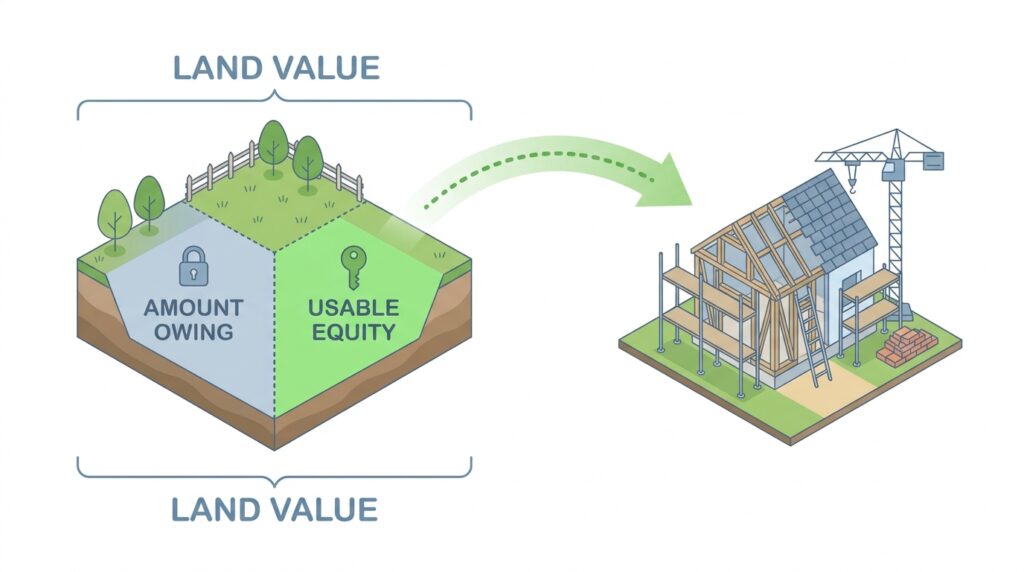
Equity is the difference between what your land is worth and what you still owe on it. If your block is valued at $400,000 and you owe nothing, you hold $400,000 in equity. If you owe $100,000, your equity is $300,000. Lenders see this as a financial buffer that reduces their risk. Many owners hold vacant land that has grown in value over time, and this property equity can become the foundation of your building budget. It is not cash in the bank, but it is an asset a lender may recognise when assessing your project.
Can You Use Land Equity to Build a New Home?
In most cases, yes. A common question is, can I use my land as equity for a construction loan? Most Australian lenders will consider it, provided you own the land, or are paying it off, and the project meets their rules. The lender takes the land and the future home as security, and the equity you hold counts towards the total project cost. The exact rules, limits and fees differ between lenders, so compare several options before you commit to one.
How Does a Land Equity Construction Loan Work?
If you are wondering how to use land equity to build a house in Australia, the process follows a clear sequence. A land equity construction loan is a form of home construction finance where the lender counts your land value as part of your contribution. You sign a building contract, the lender assesses the project, and funds are released in stages as the build progresses. You usually pay interest only on the amount drawn so far, which keeps early repayments lower. Once the home is finished, the loan typically moves to standard repayments of principal and interest.
How to Calculate the Equity in Your Land
Start with a current land valuation. A bank valuer or a licensed property valuer will assess what your block is worth today, and this figure may differ from the price you paid or the amount shown on your rates notice. Then subtract any debt secured against the land. The result is your usable equity, which is the portion a lender may allow you to put towards the build. For example, land valued at $500,000 with a $150,000 balance owing leaves $350,000. Lenders may apply their own limits and adjustments, so treat your own estimate as a starting point only.
How Much Land Equity Do You Need to Build a House?
How much land equity do I need to build a house? There is no single figure, because lenders look at the loan-to-value ratio, or LVR. This compares your loan with the combined value of the land and the finished home. Many lenders prefer an LVR of 80% or lower. Suppose your land is worth $300,000 and the build costs $500,000. The total project is $800,000, so an 80% LVR allows a loan of up to $640,000. You would need to borrow $500,000 for the build, and your land would cover the required contribution. This is an illustration only. Your borrowing capacity, based on your income and expenses, must still support the repayments.
Can You Use Land Equity If You Still Have a Mortgage?
Often, yes. If you still owe money on the block, you hold an existing land mortgage, and the lender will deduct that balance from the land value to find your equity. Some owners refinance and roll the old debt into the new loan, while others stay with their current lender. Either way, the debt counts towards your total borrowing, so it will affect how much you can access. Ask your lender to confirm exactly how the balance is treated before you sign a building contract, because changes after signing can be costly.
Can You Build a House on Land You Own Without a Deposit?
Many owners ask, can I build a house on land I own without a deposit? Often you will not need a cash payment, because the land itself can act as your construction loan deposit. If your equity meets the lender’s requirement, the block takes the place of savings. However, you still need funds for costs the loan may not cover, such as fees, insurance and some site works. Lenders may also ask for evidence of genuine savings or a stable repayment history, so check the rules early rather than assuming nothing is required upfront.
What Factors Affect Construction Loan Approval?
Construction loan approval depends on both your finances and your project. Lenders review your income, savings, debts, credit history and employment stability. They also assess the land, the builder and the contract. If you are planning on building a house using land equity in NSW, you will also need council or private certifier approval before work begins. When your LVR goes above 80%, the lender may require lenders mortgage insurance (LMI), which adds a one-off cost to the project. A pre-approval can help you set a realistic budget before you sign anything.
What Documents Do You Need to Apply for a Construction Loan?
Prepare your paperwork early to avoid delays. Lenders usually ask for proof of identity, payslips or tax returns, bank statements and your land title details. For the project, you will need a fixed-price building contract signed by you and the builder, which states the total cost and the payment schedule. You will also need building plans and specifications, which describe the design, materials and finishes in detail. Council or certifier approvals, along with the builder’s licence and insurance details, are often required as well.
How Do Construction Loan Progress Payments Work?
Progress payments release your loan in stages as the builder completes each milestone. Common stages include the slab or base, frame, lock-up, fixing and practical completion. Before each payment, the lender may ask for an invoice and a progress inspection. Because you only pay interest on the funds drawn, your repayments grow gradually as the build advances. At the end of the project, some lenders order a completed property valuation to confirm the finished home matches the expected value. Always check your contract so the payment stages line up with your loan.
What Additional Costs Should You Budget For?
The build price is rarely your only expense. Site preparation costs can include clearing, levelling, retaining walls, soil testing, drainage and temporary fencing. You may also pay for council fees, utility connections, driveways, landscaping, window coverings and legal advice. Setting aside a contingency of five to ten per cent is a common planning approach in case of variations or delays. Ask your builder which items are included in the contract and which are not, so there are no surprises once work begins.
Can You Use Land Equity to Build a Modular Home?
Modular homes are built in a factory and delivered to your site, which can shorten the on-site construction period. Modular home financing works much like other building loans, but lenders may treat the staged payments differently, because the factory build and the site works happen in separate phases. Conditions vary by lender and manufacturer, and approval or a particular borrowing amount is never guaranteed. At Home Choice Australia, we can explain how our process lines up with your payment schedule so your broker has clear information to work with.
What Are the Advantages and Risks of Using Land Equity?
The main advantage is access. You may start building without saving a large cash deposit, and you can put an asset you already own to work. It can also simplify your budget, because one loan covers the build. The risks are real, though. A drop in property values can reduce your equity, building costs can rise, and a larger loan means larger repayments. Because the lender holds your land as security, falling behind on repayments could put both the block and the home at risk. Weigh these points carefully and plan for rising interest rates.
Land Equity vs a Traditional Home Loan: What’s the Difference?
A traditional home loan funds a completed property that you buy and move into, with full repayments starting straight away. A building loan funds the work in stages and begins with interest-only repayments on drawn funds. Some buyers who do not yet own a block choose a land and construction loan, which finances the purchase and the build together. Since you already own your land, your equity does the work of the deposit, and you avoid buying twice. Compare fees, interest rates and flexibility across lenders to find the best fit.
Frequently Asked Questions About Using Land Equity to Build a Home
1. Can I use my land as security if I own it outright?
Yes, in many cases. Owning the block outright means the full value counts as your equity. The lender will still assess your income, expenses and credit history, and will want to review the builder and contract before approving the project.
2. Does the value of my block affect how much I can borrow?
Yes. A higher valuation increases your equity and may improve your position. A lower valuation can reduce what the lender allows, so it helps to request a valuation early and plan your budget around a cautious figure.
3. Do I need a builder before I apply?
Usually, yes. Most lenders want a signed building contract, approved plans and a licensed builder before they finalise the loan. You can seek a pre-approval first to understand your budget before choosing a builder.
4. Will I pay interest on the full loan from day one?
Typically no. Interest is charged on the amount released so far, so early repayments are smaller. They increase as each stage of the build is paid, until the home is finished.
5. Can I use my land if it is owned jointly?
Usually, yes, but every owner on the title generally needs to agree and sign the loan documents. Speak with your lender and a legal professional if ownership is shared or the title is complex.
6. How long does approval take?
It varies by lender and by how complete your documents are. Having your contract, plans and financial records ready can speed things up, and an early pre-approval helps you plan realistic timeframes.
Planning Your Next Step
Using the equity in your land can make building more achievable, but it works best when you understand the numbers, the lender rules and the costs before you start. Speak with a lender or broker, gather your documents and get a clear fixed-price quote. If you are ready to take the next step toward a new home in New South Wales, the Home Choice Australia team is here to help you plan with confidence.