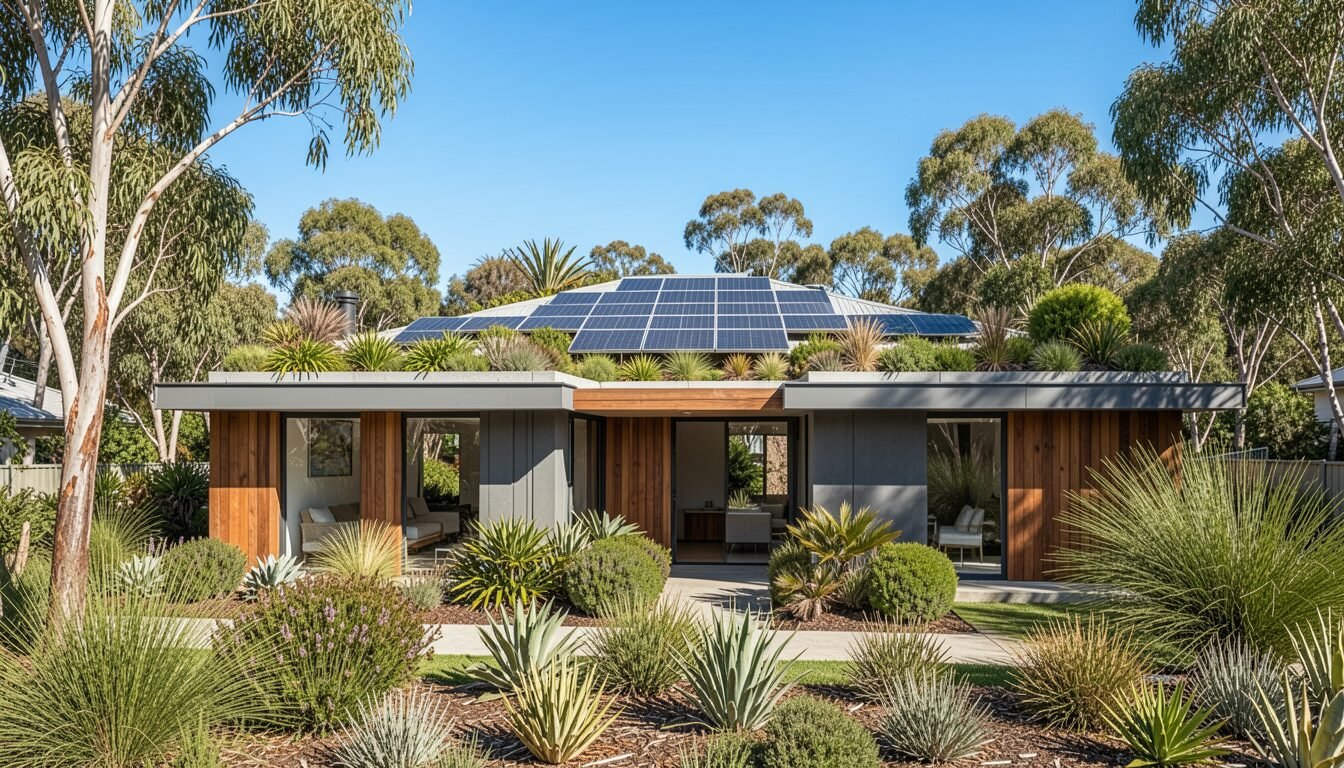
Energy prices in NSW have risen sharply over the past decade. Summers are getting hotter, winters are more unpredictable, and homeowners are paying the price — literally — for homes that were never designed to handle Australian climate conditions efficiently. At Home Choice Australia, we see a clear shift happening across New South Wales. More homeowners and first-time builders are asking not just what their home will look like, but how it will perform over its entire lifetime.
That shift is driving the rapid growth of sustainable home design across the state. This guide explains exactly what a sustainable house is, why it matters specifically for NSW homeowners, and how to build one from the ground up.
What Is a Sustainable House?
A sustainable house is a home designed to reduce its environmental impact across its entire lifecycle — from the materials used to build it, through to how it uses energy and water every single day it is occupied.
The definition goes beyond solar panels on a roof. A genuinely sustainable home design considers energy efficiency, water management, indoor environment quality, material selection, and the long-term durability of every system within the building.
The key characteristics that define a sustainable home include energy-efficient design that reduces reliance on artificial heating and cooling, a low environmental footprint through responsible material choices, a healthy indoor environment free from toxic materials and poor ventilation, and structural durability that reduces the need for early replacement or renovation.
Importantly, a sustainable house is also designed for future adaptability — it can accommodate changes in technology, family needs, and climate conditions without requiring a complete rebuild.
Why Sustainable Homes Matter in NSW
Environmental Benefits
New South Wales residential buildings contribute significantly to the state’s total carbon emissions. A well-designed eco-friendly house reduces carbon output through lower energy consumption, construction waste reduction, and the use of recycled building materials. Reducing resource consumption at the design stage has a compounding effect — every kilowatt-hour of energy a home does not need to draw from the grid is a kilowatt-hour that does not require generation.
Financial Benefits
Lower utility bills are the financial benefit most homeowners notice first. A properly insulated, well-oriented home with solar photovoltaic panels and energy-efficient appliances can reduce household energy costs by 40 to 70 percent compared to a conventional build. Over a 25-year mortgage period, those savings are substantial.
Sustainable homes also command higher property values in the NSW market. Buyers increasingly factor running costs and energy ratings into purchase decisions. A home with a strong NABERS rating or documented energy performance is a more attractive asset than one without.
Lifestyle Benefits
Better indoor air quality is one of the most underappreciated benefits of sustainable home construction. Homes built with low-VOC paints, non-toxic materials, and proper natural ventilation deliver measurably healthier living environments. Thermal comfort throughout the year — staying warm in winter and cool in summer without constantly running heating and cooling systems — improves daily quality of life in ways that are difficult to put a price on.
NSW Regulations for Sustainable Homes
What Is BASIX?
BASIX — the Building Sustainability Index — is a mandatory sustainability assessment that applies to all new residential developments in NSW. Before you can receive council approval for a new home, your design must pass BASIX assessment across three areas: water efficiency, energy efficiency, and thermal comfort performance.
BASIX requirements are not optional. Every new home and significant renovation in NSW must include a BASIX certificate as part of the Development Application or Complying Development Certificate process. Working with a builder and designer who understands BASIX requirements from the start saves time, cost, and the risk of having to redesign after plans are already drawn.
Sustainable Buildings SEPP
The Sustainable Buildings State Environmental Planning Policy (SEPP) operates alongside BASIX as part of NSW’s broader strategy for reducing emissions from the built environment. It applies to new builds and certain renovations, and it reflects the NSW government’s commitment to aligning residential construction with the state’s net-zero targets. Understanding how the Sustainable Buildings SEPP affects your project is an important early conversation to have with your architect or builder.
Key Features of a Sustainable House
1. Energy Efficiency
Energy-efficient homes use less power to maintain comfortable living conditions. Solar panels are the most visible element, but the system behind them matters too. Battery storage allows households to use solar-generated power after dark, reducing grid dependence further. LED lighting throughout the home and energy-efficient appliances with high star ratings round out a complete approach to energy performance.
2. Passive Design
Passive solar design is the foundation of truly sustainable home construction in NSW. Orienting your home with main living areas facing north maximises winter sun penetration while roof overhangs shade windows during summer. Natural ventilation driven by smart window placement reduces the need for mechanical cooling. Thermal mass — using materials like concrete, brick, or rammed earth that absorb and slowly release heat — stabilises internal temperatures naturally.
These passive design principles work with Australia’s climate rather than against it. They reduce the load on active systems and deliver thermal comfort without ongoing energy costs.
3. Sustainable Building Materials
Material selection has a direct impact on both the environmental footprint and the long-term performance of your home. Sustainable timber from certified sources, recycled building materials, insulated panels, and rammed earth construction all carry lower embodied carbon than conventional alternatives. Lifecycle assessment thinking — asking how long a material will last and what happens at end of life — leads to better long-term decisions than simply choosing the cheapest option at construction stage.
4. Water Efficiency
Rainwater harvesting through properly sized rainwater tanks reduces reliance on municipal water supply. Greywater recycling systems treat and reuse water from showers and basins for garden irrigation. Low-flow fixtures throughout the home reduce consumption further. Together, these systems can cut household water use significantly — a meaningful benefit in a state that regularly faces water restrictions.
5. Insulation and Airtightness
High-quality insulation in walls, ceilings, and floors is the single most cost-effective investment in energy-efficient housing. Double glazing on windows prevents heat transfer in both directions — keeping warmth in during winter and heat out during summer. Airtightness, achieved through careful construction detailing, prevents the uncontrolled air leakage that undermines the performance of even well-insulated homes.
Step-by-Step Guide: How to Build a Sustainable House in NSW
Step 1: Choose the Right Location and Orientation
Your block’s orientation determines how much passive solar benefit your home can capture. In NSW, a north-facing living area with appropriate eave depth delivers significant passive heating in winter and shading in summer. Consider the local climate zone — coastal NSW, inland NSW, and alpine areas all have different design priorities.
Step 2: Work With Sustainable Architects and Builders
Experience in eco-friendly house design and specific knowledge of BASIX requirements and NSW building code sustainability standards is essential. Ask builders for examples of sustainable home construction projects they have completed. The design decisions made at this stage have the largest impact on your home’s long-term performance.
Step 3: Design for Passive Living
Reduce your home’s reliance on mechanical heating and cooling from the ground up. Passive house principles — though distinct from the certified Passive House standard — inform a design approach that uses far less energy than conventional construction. Focus on insulation depth, window placement, and thermal mass before specifying any active systems.
Step 4: Select Eco-Friendly Materials
Prioritise locally sourced materials to reduce transport emissions. Choose products with low embodied carbon and established durability in Australian climate conditions. Specify non-toxic paints and adhesives throughout. These choices protect both the environment and the health of everyone living in the home.
Step 5: Install Renewable Energy Systems
Solar PV combined with battery storage gives your home genuine energy independence. Size your system based on your household’s actual consumption patterns, not a generic recommendation. A properly sized solar and storage system, combined with an energy-efficient design, can reduce your grid energy use to near zero.
Step 6: Optimise Water Management
Design your rainwater harvesting system to match your block’s catchment area and your household’s needs. Integrate greywater recycling for garden use where council regulations permit. Specify efficient plumbing fixtures throughout from the initial fitout rather than retrofitting later.
Step 7: Ensure BASIX Compliance
Your BASIX certificate must be obtained before council approval. Design your home to meet or exceed BASIX requirements — not just to satisfy the minimum threshold but to deliver genuine long-term performance. A home designed to the minimum often underperforms in real-world conditions compared to its assessment score.
Passive House vs Sustainable House
A Passive House is a specific certified standard focused on ultra-low energy use through extreme airtightness, high-performance insulation, mechanical heat recovery ventilation, and minimal thermal bridges. It is a rigorous, measurable standard with international certification.
A sustainable house is a broader concept that encompasses energy efficiency, water management, material responsibility, and environmental impact. Not all sustainable homes meet the Passive House standard, but all Passive Houses are sustainable homes.
For most NSW homeowners, a well-designed sustainable home using passive solar design principles delivers an excellent outcome without the additional cost and complexity of full Passive House certification.
Cost of Building a Sustainable House in NSW
Sustainable home construction in NSW typically costs 5 to 15 percent more upfront than a conventional build of equivalent size. However, the return on investment through lower utility bills, reduced maintenance costs, and higher resale value makes this premium financially sound over any realistic ownership period.
Government incentives in NSW and at the federal level — including rebates for solar systems and battery storage — reduce the effective upfront cost further. The long-term savings in energy and water costs compound year after year, making sustainable living in NSW not just an environmental choice but a financially intelligent one.
Common Mistakes to Avoid
Ignoring orientation is the most costly mistake in sustainable home design — no amount of technology compensates for a home that faces the wrong direction. Poor insulation specification undermines every other sustainability measure. Over-reliance on active technology like solar and battery storage without first addressing passive design is an expensive approach that delivers mediocre results. Failing to meet BASIX standards causes approval delays and forces redesigns that could have been avoided with proper planning from the start.
Future Trends in Sustainable Housing in Australia
Net-zero homes — buildings that produce as much energy as they consume annually — are becoming the benchmark rather than the aspiration across the NSW market. Smart home integration connects energy management, lighting, water systems, and climate control into coordinated systems that optimise performance automatically. Off-grid living is increasingly viable as battery storage costs continue to fall. Climate-resilient design, accounting for more extreme weather events, is becoming a standard consideration in new home planning rather than an optional extra.
Conclusion
A sustainable house is not a niche product for environmentally motivated buyers. It is the logical evolution of residential construction in NSW — driven by rising energy costs, stricter regulations, and a growing understanding that the way we build homes today has consequences for decades to come.
At Home Choice Australia, we believe that sustainability starts with design, not technology. The smartest sustainable homes use passive design principles to reduce the load on active systems, choose materials that last, and comply with BASIX and NSW building code sustainability requirements from the first drawing. Get those fundamentals right, and you build a home that is comfortable, efficient, valuable, and genuinely good for the environment — for the entire time you live in it.