
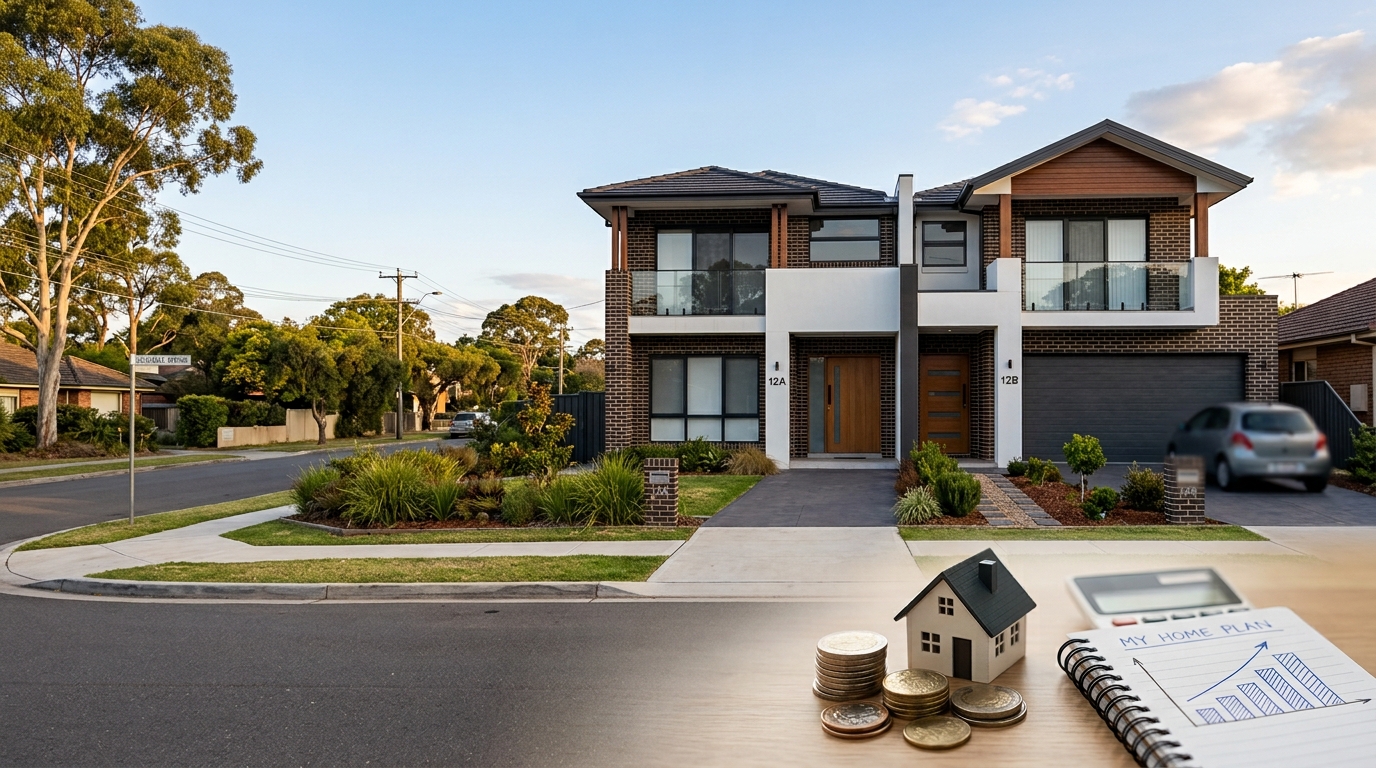
Homechoiceaustralia is a home development company in New South Wales, and investors often ask us whether a duplex beats a traditional house. The short answer is that it can, but only when the site, the numbers and the approvals line up. This guide walks through how duplexes work, what they cost, how they perform and where investors go wrong.
What Is a Duplex?
A duplex is two dwellings on one lot. Planners call this a dual occupancy, and the homes can be attached or detached. Ownership usually takes one of two forms:
- One title: you own the lot and both homes together.
- Two titles: the lot is subdivided so each home is sold or financed separately. Torrens title gives you your own lot with no shared body corporate. Strata title means owning a unit plus a share of common property, with a levy structure.
Why Duplexes Are Popular in Sydney
Land is expensive, and duplexes make better use of it. Buyers want larger, low-maintenance homes without paying for a detached house on a full block. Investors like the idea of two dwellings on one land purchase, and dual-income households like the flexibility of living in one home while renting out the other.
Are Duplexes a Good Investment?
They can be, for several reasons:
- Two rental incomes from one site
- A strong land component, which drives long-term capital growth
- Equity created through development, when the finished value exceeds total project cost
- Potentially better yield than a single house on the same land
Whether it works depends on land price, construction cost, rents, resale values and holding costs. A duplex that looks good on paper can fail if any one of those assumptions is wrong.
Buying vs Building
There are several ways in:
- Buy a completed duplex: less risk and immediate income, but less chance to create equity.
- Knockdown and rebuild: buy an older house, demolish it and build two homes.
- Buy land and develop: suits investors comfortable with the process.
Once complete, you can hold both homes as rentals, sell both, or sell one and keep one. Each path has different tax, finance and cash-flow consequences, so get personal advice before choosing.
Financial Advantages
- Dual rental income
- Shared land and construction costs
- Potential equity uplift
- Two tenants reduce the impact of a single vacancy
- Flexible resale options
The Costs
Budget for the whole project, not just the build:
- Land price, stamp duty and acquisition costs
- Demolition
- Architectural and design fees
- Planning and approval costs
- Construction
- Council contributions and infrastructure charges
- Subdivision and registration costs
- Finance and holding costs
- A contingency budget, commonly 5 to 10 percent
Most failed projects were underbudgeted, not badly designed.
Rental Yield and Cash Flow
Gross yield is annual rent divided by property value. Net yield subtracts running costs such as rates, insurance, maintenance, vacancy and property management. Estimate rent separately for each dwelling using local comparables. Compare the combined income with what a single house on the same land would earn, and remember that newer homes usually have lower maintenance costs in the early years.
Capital Growth Potential
Land value drives most long-term growth. Suburb fundamentals matter: transport, schools, employment and lifestyle. Family-sized housing is in steady demand, and good design and finishes improve resale appeal. The main threat is oversupply. If many similar duplexes are completed in one suburb, resale prices and rents can soften.
Where Can You Build a Duplex in NSW?
Check these before you buy land:
- Zoning: duplexes are permitted in R2 zones state-wide, and possibly in other zones depending on the local plan.
- Lot size and frontage: under the Low and Mid-Rise Housing reforms, the general state standard is 450 m² with a 12 m width in designated areas, and some councils differ.
- Site shape and access: narrow, sloping or irregular blocks limit design.
- Local council controls
- Flood, bushfire, heritage and easements
Confirm development potential before you sign a contract, not after.
Planning and Approval Process
The main pathways are a Development Application (DA), assessed by council on merit, and a Complying Development Certificate (CDC), a faster route when every fixed standard is met. Whichever route you take, you will need:
- A site assessment
- Architectural drawings and a site plan
- Construction approval
- Building certification during works
- An Occupation Certificate at completion
- Subdivision registration if you want separate titles
A DA is slower but more flexible, while a CDC is quicker but stricter. One non-compliant item can push a project out of the CDC pathway, so ask a certifier or planner early. Plans must also meet the current building regulations and the National Construction Code.
Torrens vs Strata Title
Torrens title gives full ownership of your lot, no body corporate and more freedom to renovate. Strata title involves shared areas, levies and rules, and renovations often need committee approval. Torrens homes often appeal more to owner-occupiers, which can support resale value. Strata may suit some projects where lot size limits subdivision. Choose based on your strategy, and seek legal advice.
Key Risks
- Construction cost overruns
- Approval delays
- Interest and holding costs
- Choosing the wrong site
- Overestimating resale values
- Rental vacancies
- Local oversupply
- Shared-wall and privacy issues
How to Assess a Duplex Before Investing
- Research recent comparable sales.
- Check local rental demand.
- Calculate total project cost.
- Estimate end value.
- Calculate expected rental return.
- Allow for unexpected costs.
- Check council planning controls.
- Stress-test the numbers: What if costs rise 10 percent, values fall 10 percent, or rates rise?
Illustrative Example
These figures are hypothetical, for illustration only. Actual numbers vary widely.
- Land and acquisition costs: $1,300,000
- Demolition, design, approvals and contributions: $150,000
- Construction of two homes: $1,100,000
- Finance and holding costs: $100,000
- Total project cost: $2,650,000
- Expected value of two homes: $3,000,000
- Expected rent: $1,100 per week each, or about $114,400 a year combined
- Gross rental yield on end value: about 3.8 percent
- Potential equity position: about $350,000, before selling costs and tax
Now change one assumption. If each home values at $1,350,000 instead, the equity uplift shrinks to about $50,000. That is why stress-testing matters.
Suburb and Location Factors
Look for:
- Transport access and employment centres
- Schools and amenities
- Family-oriented streets
- Land values relative to likely sale prices
- Rental demand
- Existing duplex supply
- Nearby development activity
Duplex vs House vs Apartment
- Land component: the duplex and house have it; apartments have little.
- Costs: a duplex needs more capital than a house, but usually less per dwelling than two separate lots.
- Rental income: duplexes give two streams; houses and apartments one.
- Maintenance: duplexes and houses are your responsibility; apartments usually involve levies.
- Privacy: duplexes involve shared walls or close neighbours.
- Resale: houses have the broadest buyer pool; duplexes appeal to owner-occupiers and investors.
How to Improve Returns
- Choose the right site
- Avoid overcapitalising
- Optimise floor plans and building materials for cost and durability
- Provide separate access
- Design for tenant demand
- Select appropriate finishes
- Consider future subdivision
- Compare selling vs holding
Common Mistakes
- Buying unsuitable land
- Ignoring zoning restrictions
- Underestimating total costs
- Relying on optimistic resale prices
- Forgetting holding costs
- Poor orientation or layout
- Ignoring local demand
- Skipping professional feasibility advice
Is a Duplex Better for Selling or Renting?
It depends on your goals. Selling both homes crystallises profit and repays debt. Selling one and keeping the other can recover most of your costs while retaining a rental. Holding both maximises income and long-term growth but requires cash-flow strength. Owner-occupying one and renting the other reduces your living costs. Your finance position, tax situation and time horizon should decide.
Final Word
A Sydney duplex can be a strong investment when the site is right, the costs are realistic and the numbers hold up under stress. This guide is general information, not financial or legal advice, so speak with a licensed adviser before you invest. If you’d like feasibility support for a duplex project, the Homechoiceaustralia team is ready to help.