
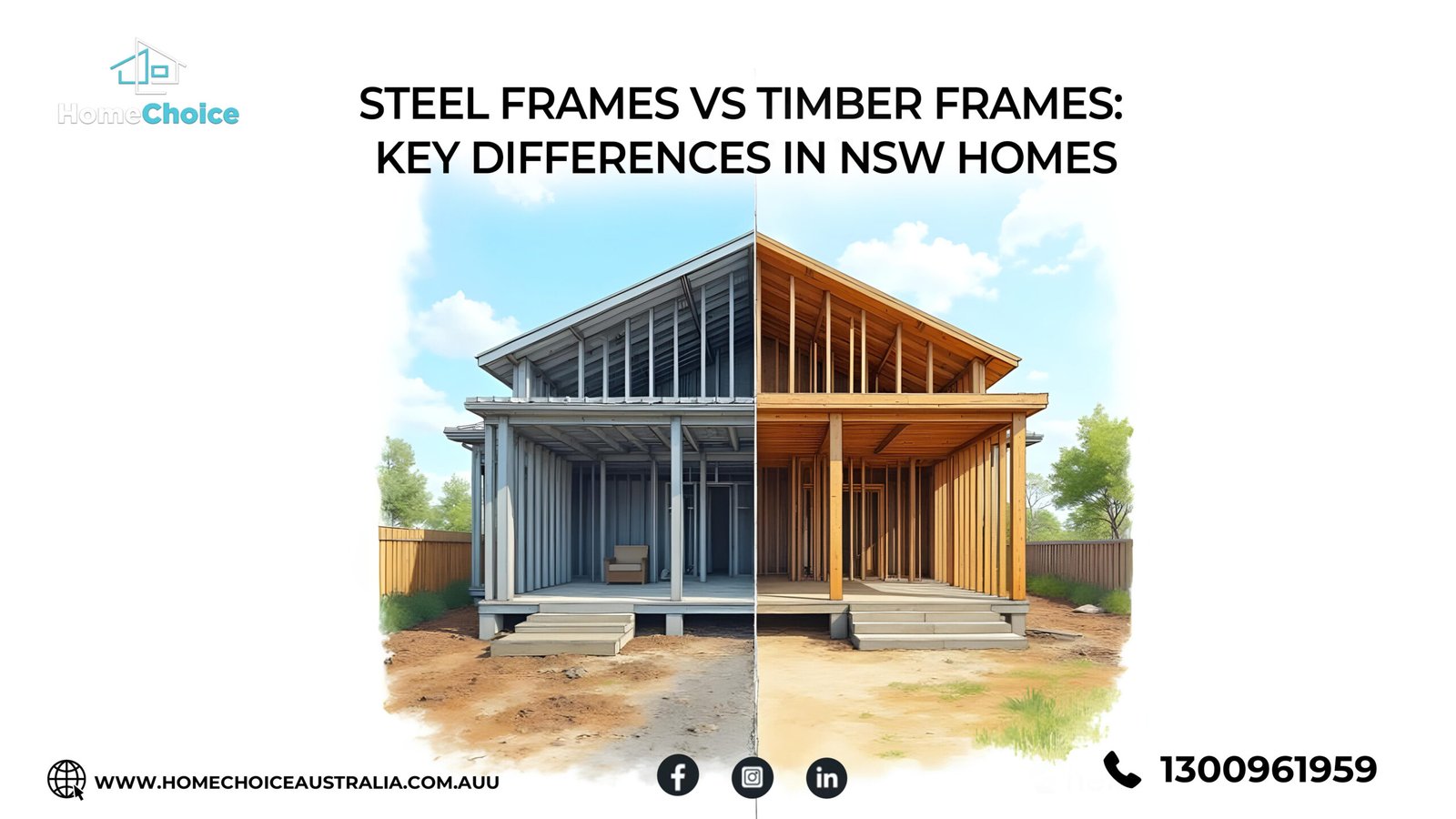
When planning a new home or extension in New South Wales, one of the most critical decisions you’ll make is choosing between steel frames vs timber frames. This choice affects everything from structural integrity and durability to long-term maintenance and overall construction cost. At Home Choice Australia, we understand that NSW homeowners face unique challenges—from bushfire-prone areas to coastal humidity and termite activity—making the selection of framing materials more important than ever.
This comprehensive guide examines steel frame vs timber frame houses across multiple factors, helping you make an informed decision for your residential construction project in Erina NSW and throughout the Central Coast.
What Is Steel Frame Construction?
Steel frame construction uses light gauge steel members as the primary structural framing materials Australia-wide. These cold-formed steel sections are precision-engineered and often prefabricated off-site, ensuring consistent quality and dimensional accuracy. Steel framing for coastal areas NSW has become increasingly popular due to its resistance to moisture and corrosion when properly treated.
Residential steel framing Australia typically involves galvanized steel studs, joists, and rafters that form the skeleton of both single-storey homes and double-storey homes. The material’s load-bearing capacity makes it ideal for custom homes requiring large open spaces without internal support walls.
What Is Timber Frame Construction?
Timber frame construction NSW relies on traditional softwood species, primarily pine, which has been the backbone of Australian residential building for generations. Timber framed homes Australia showcase natural insulation properties and have established themselves as a trusted choice among local builders Erina NSW and throughout New South Wales residential building sectors.
The timber house frames NSW industry continues to thrive, particularly for project homes and renovations and extensions where builders leverage decades of experience with this familiar material. Timber framing for residential homes offers natural warmth and proven performance when properly maintained.
Material Properties & Structural Performance
Strength & Load-Bearing Capacity
When comparing steel vs timber house frames NSW, the structural differences are significant. Steel possesses a superior strength-to-weight ratio, allowing for longer spans and potentially reduced foundation requirements. Engineering certification for steel framing demonstrates its exceptional load-bearing capacity, particularly important for double-storey construction or homes with complex roof designs.
Timber provides adequate compressive strength for most residential applications, though it requires larger member sizes to achieve equivalent performance. Both materials meet NCC (National Construction Code) requirements when properly specified and installed.
Dimensional Stability
A crucial distinction in steel framing vs timber framing Australia lies in dimensional stability. Steel resists warping, twisting, and shrinkage regardless of environmental conditions, maintaining structural integrity throughout the building’s lifespan. This stability translates to fewer callbacks for door and window adjustments.
Timber’s susceptibility to moisture resistance challenges means it can expand, contract, or warp based on humidity levels—a particular concern in coastal home construction NSW where moisture levels fluctuate seasonally.
Durability & Lifespan
The lifecycle cost comparison between steel vs timber durability reveals important considerations for NSW building standards framing decisions. Steel framed houses Australia, when using quality galvanized or zinc-coated materials, demonstrate excellent corrosion resistance and typically outlast timber alternatives in challenging environments.
Steel vs timber termite resistance is perhaps the most compelling advantage for steel. Termite protection remains a constant concern for timber framing, requiring chemical treatments, physical barriers, and ongoing inspections. Steel eliminates this vulnerability entirely, offering genuine pest resistance that reduces long-term maintenance requirements.
In bushfire-prone areas, steel vs timber fire resistance Australia becomes a critical safety consideration. Steel provides superior fire compliance compared to timber, maintaining structural integrity longer during fire events. BAL ratings (Bushfire Attack Level) are more easily achieved with steel frame homes New South Wales, potentially reducing insurance premiums.
However, timber doesn’t face rot and decay issues when properly protected, and modern treatment methods have significantly improved its durability profile.
Climate & Local Conditions in NSW
Performance varies significantly between humid coastal vs inland climates. Home builders Erina NSW understand that Central Coast home framing must withstand salt-laden air and high humidity. Steel’s moisture resistance makes it particularly suitable for residential construction Erina and similar coastal environments, though premium coatings are essential.
For bushfire-prone areas throughout NSW, steel framing offers inherent advantages in thermal performance during fire events. Australian Standards mandate specific cyclonic and wind rating requirements for house construction Central Coast NSW, and steel typically achieves these with lighter structural members than timber equivalents.
Cost Comparison
Upfront Materials & Construction
The steel vs timber construction cost NSW equation involves multiple variables. Initial construction cost for steel frames typically runs 10-20% higher than timber, though this gap has narrowed as timber prices have increased. Material availability and labour cost NSW also influence the final equation, with timber installation generally requiring less specialized skills.
Installation time favors steel when prefabrication is utilized, potentially offsetting higher material costs through reduced labour hours. The slab and frame construction timeline can be significantly compressed with steel.
Long-Term Value
While upfront costs matter, long-term maintenance considerations change the financial picture. Steel’s minimal maintenance requirements, elimination of termite treatment costs, and potential insurance savings contribute to favorable lifecycle cost outcomes. The warranty and lifespan of steel framing often extends 50+ years with virtually no maintenance.
Timber requires ongoing investment in termite inspections, potential treatments, and possible repairs for moisture-related issues, though these costs remain manageable with proper preventative measures.
Environmental Impact
For sustainable building materials selection, both options present valid arguments. Timber functions as a renewable resource, absorbing carbon dioxide during growth, potentially offering a lower carbon footprint when sourced from responsibly managed forests. It represents an eco-friendly construction choice from a renewability perspective.
Steel recyclability stands at nearly 100%, and modern steel often contains significant recycled content. However, the embodied energy in steel production is substantially higher than timber processing. The environmental impact assessment depends on whether you prioritize renewable sourcing or recyclability and long-term durability reducing replacement needs.
Construction Speed & Accuracy
Steel frame construction NSW benefits enormously from prefabrication. Factory-controlled manufacturing ensures precision, reduces on-site waste, and accelerates project timelines. Home construction Central Coast NSW builders increasingly leverage this advantage for tighter project scheduling.
Timber provides greater on-site flexibility for adjustments and modifications, valuable during renovations and extensions where existing structures may require adaptation. Traditional framing methods allow for easier field changes without factory lead times.
Thermal & Acoustic Performance
Natural thermal performance favors timber, which provides inherent insulation properties. Steel conducts heat readily, creating thermal bridging concerns that require additional insulation strategies to achieve equivalent energy efficiency. Both materials can achieve excellent acoustic insulation when proper design techniques are employed.
Expansion and contraction noises can occur with steel framing during temperature fluctuations, though proper detailing minimizes this issue in quality construction.
Design Flexibility & Aesthetics
Both steel framing and timber framing support diverse architectural designs. Steel’s strength enables larger open-plan spaces and floor-to-ceiling glazing without intermediate supports. Timber’s traditional aesthetic appeals to those seeking classic residential character.
Interior and exterior finish considerations remain largely identical—both accept standard cladding, lining, and finishing materials equally well.
Practical Considerations for NSW Builders & Homeowners
Availability of skilled labour varies regionally. Timber framers remain more numerous across NSW, while steel framing specialists concentrate in urban and growth areas. Both materials require compliance with Building codes NSW and regulatory requirements.
Insurance companies increasingly recognize steel’s advantages in bushfire and termite-prone regions, sometimes offering reduced premiums for steel framed construction.
When to Choose Steel Frames
Steel frames excel in:
- Bushfire-prone areas requiring strict BAL compliance
- Coastal environments with high humidity and salt exposure
- Areas with significant termite activity
- Projects prioritizing long-term durability over initial cost
- Designs requiring large open spans or complex engineering
- Situations where dimensional stability is critical
When to Choose Timber Frames
Timber frames suit:
- Budget-conscious projects where initial cost is paramount
- Traditional home designs emphasizing natural materials
- Areas with ready access to skilled timber framers
- Projects prioritizing natural insulation and thermal mass
- Renovations matching existing timber construction
Conclusion
The choice between steel frame vs timber frame houses ultimately depends on your specific circumstances, priorities, and location. For Central Coast home framing and coastal home construction NSW, steel offers compelling advantages in durability, termite protection, and bushfire resistance. However, timber remains a viable, cost-effective option for many NSW residential building projects.
At Home Choice Australia, we recommend steel framing for bushfire zones, coastal locations, and homeowners prioritizing lifecycle value and minimal maintenance. Timber suits budget-focused projects and traditional designs where environmental conditions are less demanding.
Both steel vs timber framing options deliver quality outcomes when properly designed and constructed to Australian Standards. Consider your site conditions, budget, long-term plans, and local environmental factors when making this crucial decision for your new home or extension project.