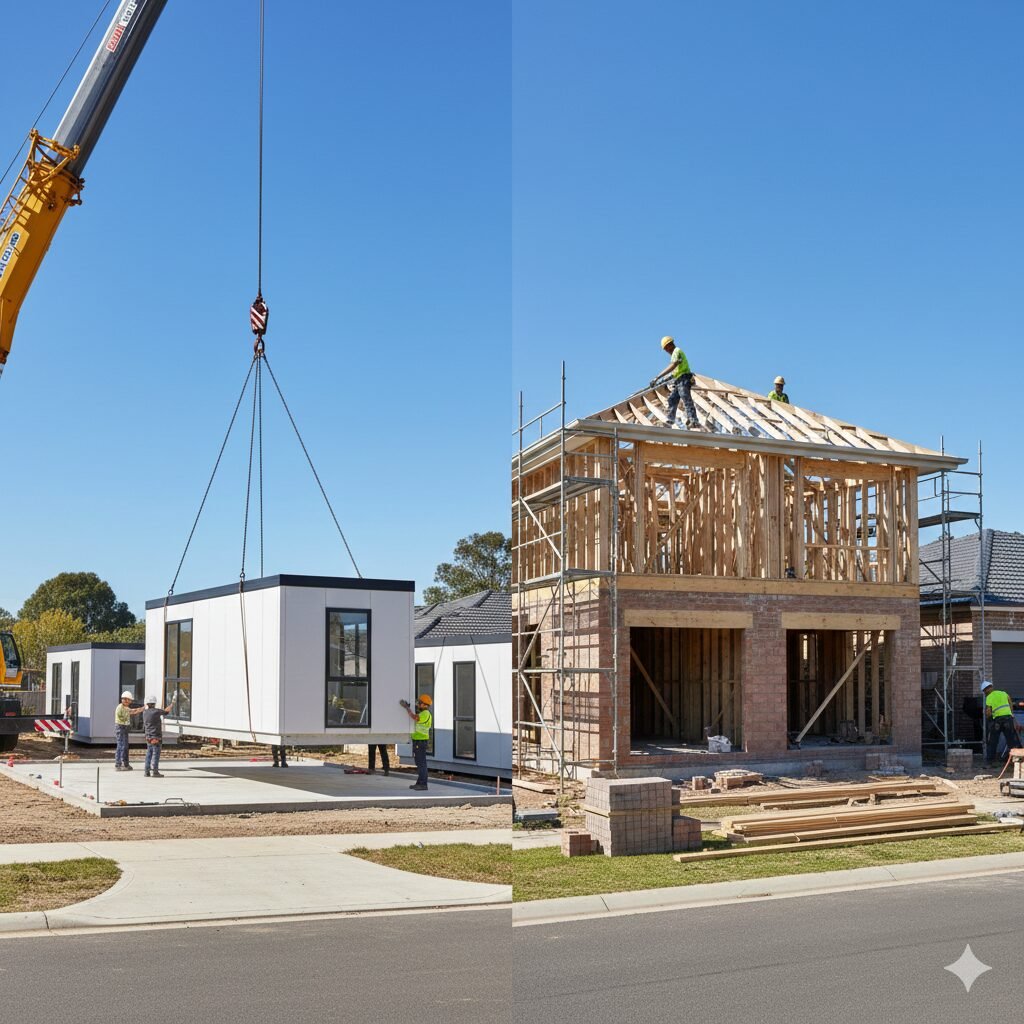
Erina, a thriving commercial hub on the Central Coast, is seeing more homeowners explore alternatives to standard house construction. Whether you’re planning a first home, knock-down rebuild, or downsizer dwelling, the choice between modular vs traditional homes Erina NSW matters for your budget, timeline, and lifestyle. Modular homes Erina NSW are factory-built in controlled environments and transported to site, while traditional homes Erina NSW involve full on-site construction from foundation to roof. Generally, modular construction suits buyers seeking cost certainty and faster timelines, whereas traditional home construction Erina NSW offers maximum on-site customisation and suits complex or sloping blocks.
What is a Modular Home vs a Traditional (Stick-Built) Home?
Modular homes are prefabricated homes Erina NSW built in sections (modules) at an off-site factory, then transported and assembled on your prepared foundation. Factory-built homes undergo quality checks in climate-controlled facilities, reducing weather-related delays. Typical build timeframes range from four to twelve weeks in the factory, plus several days for delivery and installation.
Traditional homes use on-site building methods where timber frame construction or brick veneer homes are erected entirely on your block. Builders coordinate trades, materials arrive progressively, and construction progresses through framing, roofing, fit-out, and finishes over several months. This approach allows real-time design changes but is vulnerable to construction delays from weather, labour availability, and material supply.
Key differences:
- Manufacturing: Modular = factory production line; Traditional = on-site assembly
- Timeline: Modular typically 3–5 months total; Traditional 6–12+ months
- Quality control: Factory inspection vs on-site supervision
- Weather impact: Minimal (modular) vs significant (traditional)
Key Comparison: Modular vs Conventional Homes Central Coast
| Factor | Modular Homes | Traditional Homes |
| Build Time | 3–5 months (factory + install) | 6–12+ months |
| Typical Cost | Competitive fixed pricing; $200k–$450k+ turnkey | Variable labour costs; similar range but less predictable |
| Cost Certainty | High — factory quotes lock in material costs | Lower — subject to material price changes, weather delays |
| Quality Control | Factory QA, computer-aided precision | Dependent on builder and site conditions |
| Weather Delays | Minimal (factory-built) | Common (rain, wind affect framing, concrete) |
| Customisation | Moderate — within factory floor plans | Extensive — bespoke designs possible |
| Transport/Crane | Requires crane hire, wide access | Standard truck deliveries |
| Council Approvals | Same as traditional — DA + CC, BASIX required | Same process, building approvals NSW apply |
| Resale Value | Comparable when built to NCC standards | Traditional perception may favour conventional |
| Sustainability | Often exceeds energy efficiency standards, better insulation standards | Varies by builder; can achieve high NatHERS ratings |
Local Considerations for Erina and Central Coast Blocks
When comparing modular vs brick homes NSW or prefab vs traditional homes Australia on the Central Coast, site logistics matter significantly.
Site Access & Transport
Modular sections arrive on large trucks and need crane access to lift modules onto the slab foundation. Erina’s established streets vary in width — some older residential zones have narrow roads or overhead power lines that complicate delivery. Before committing, arrange a site inspection with your modular home builders Erina to assess:
- Road width and turning circles
- Overhead obstacles (power lines, tree canopies)
- Crane positioning space adjacent to the footprint
- Potential traffic management or council notifications
Council Approvals & BASIX Requirements
Both modular and traditional construction require Central Coast Council development approval and comply with BASIX requirements (Building Sustainability Index), the NCC (National Construction Code), and local zoning regulations. Modular homes for coastal areas NSW must demonstrate:
- Energy efficiency (insulation, glazing, ventilation)
- Water efficiency targets
- Compliance with coastal climate and bushfire regulations (BAL ratings if applicable)
Engage with council approvals Central Coast early — turnaround for approvals can be six to twelve weeks. Some modular builders offer turnkey packages that include BASIX documentation and council liaison.
Soil & Foundations
The Central Coast features variable soil conditions — sandy coastal soils, clay pockets inland. Most modular installations use a prepared slab foundation (engineered and poured prior to module delivery), though pier footings suit sloped sites. Traditional builds also require site preparation but can adapt footing design progressively. Engage a soil engineer to test bearing capacity and drainage regardless of construction method.
Neighbour Notifications & Crane Timing
Crane lifts for modular installs typically occur within a single day, but the noise and road access impact neighbours. Coordinate timing and notify adjacent residents. Some Central Coast streets require parking restrictions or temporary road closures — your builder should arrange council permits.
Costs & Budgeting: Realistic Expectations for Erina
Where Modular Can Save
The cost of modular homes in NSW benefits from:
- Bulk material purchasing by factories
- Reduced on-site labour costs (no prolonged trade coordination)
- Less weather-related downtime and wastage
- Budget certainty via fixed pricing contracts
Where Costs Add Up
Modular projects incur:
- Transport fees (distance from factory to Erina)
- Crane hire (typically $2,000–$5,000 depending on site complexity)
- Site preparation (slab, services, stormwater compliance)
- Connection of utilities (plumber/electrician for final hookups)
- Landscaping and driveway (usually excluded from base quotes)
Traditional Home Building Costs Erina
Traditional house builders Central Coast quote per square metre or lump sum, but final costs fluctuate with material costs, construction delays, and variation requests. Labour costs on the Central Coast are competitive but subject to trade availability.
Sample Budget Checklist
To compare apples-to-apples, request quotes covering:
- Siteworks: clearing, excavation, slab/footings
- Building structure: modular modules delivered and installed OR full on-site framing and roofing
- Services: plumbing, electrical, HVAC roughed-in and connected
- Council fees: DA, CC, BASIX certification
- Crane/transport (modular only)
- Finishes: flooring, painting, fixtures, cabinetry
- External: driveway, fencing, landscaping
Ask modular firms for turnkey quotes to avoid surprise add-ons.
Timeline: How Long Until You Move In?
Modular Home Construction Timeline
- Design/approvals: 6–12 weeks (council DA + engineering)
- Factory build: 4–12 weeks (modules constructed, inspected, transported)
- Site install: 1–3 days (crane lift, securing modules)
- Finishing trades: 2–4 weeks (connections, paint touch-ups, landscaping)
- Total: Approximately 3–5 months from approval to occupancy
Traditional Build Schedule
- Design/approvals: 6–12 weeks
- Slab/footings: 2–4 weeks
- Frame/roof: 6–10 weeks (weather-dependent)
- Lockup stage: Additional 4–8 weeks (windows, external cladding)
- Fit-out/finishes: 6–12 weeks (internal trades, fixtures)
- Total: Typically 6–12 months, longer if weather disrupts
Local tip: Central Coast winters (June–August) bring rain that delays traditional framing. Plan crane installs for modular builds during calmer months (spring/autumn) for smoother logistics.
Quality, Energy Efficiency & Sustainability
Modular construction excels in factory QA — computer-controlled cutting, consistent framing tolerances, and inspection at each stage reduce defects. Modules often achieve superior weather resistance and insulation standards because joints are sealed in controlled conditions.
Both modular and traditional homes can meet or exceed NatHERS ratings (6-star minimum in NSW) and BASIX compliance. Sustainable housing features like double glazing, efficient HVAC, and water tanks are standard in quality modular designs. Traditional builds offer flexibility to incorporate passive solar design or unique materials, though execution depends on builder diligence.
Long-term durability: Properly engineered modular homes using steel chassis and treated timber perform identically to traditional timber-frame homes. The key is ensuring compliance with NCC structural standards and engaging licensed builders for both methods.
Which Option Suits Different Buyers in Erina?
First-Home Buyers on Budget
If budget certainty and speed matter, explore best modular home builders Erina offering entry-level packages. Traditional builders can also deliver economical designs, but ensure fixed-price contracts to avoid cost blowouts.
Renovators / Knock-Down Rebuilds
Erina’s established suburbs contain older homes on valuable blocks. For knock-down rebuilds, modular homes near Erina NSW reduce neighbourhood disruption (shorter build time, less noise). Traditional builds suit buyers wanting bespoke architectural features or complex split-level designs on slopes.
Downsizers / Granny Flats / Secondary Dwellings
Modular granny flats are increasingly popular for home construction options in Erina NSW. Compact, affordable, and fast to install, they suit aging parents, teenage retreats, or rental income. Many custom modular homes Central Coast providers specialise in secondary dwellings under 60m² that bypass full DA requirements (subject to local rules).
Local Suppliers & Builders to Contact
When researching new home builds Erina NSW or new house construction Central Coast, consider these established modular and traditional providers:
Modular Specialists:
- Keep Modular — offers customisation options with energy-efficient designs suited to coastal climates
- AJC Modular — known for turnkey packages including BASIX, transport, and crane coordination
- Coast Modular — local Central Coast presence, specialises in granny flats and dual-occupancy modules
- Central Coast Tiny Homes — compact, sustainable designs for downsizers and small blocks
Tip: Request references from past Central Coast projects, ask for delivery photos showing crane lifts, and confirm whether quotes include council approvals and siteworks.
For traditional home builders near Erina, approach licensed builders with portfolios demonstrating weather-resistant construction and familiarity with Central Coast Council processes.
At Home Choice Australia, we connect Erina homeowners with vetted modular and traditional builders, ensuring you receive transparent quotes and expert guidance tailored to your block.
Common Questions: Modular vs Traditional Homes
Are modular homes allowed by Central Coast Council?
Yes. Modular homes require the same development approval (DA) and construction certificate (CC) as traditional builds. They must comply with BASIX, NCC, and local zoning regulations. Council treats them identically in the approval process.
Do modular homes appreciate like traditional homes?
When built to identical standards, investment value and resale value are comparable. Lenders and valuers assess construction quality, location, and finishes — not whether the home was factory-built or site-built. Ensure your modular home meets NCC and has proper engineer certifications.
Will my block accept a modular delivery?
Site access determines feasibility. Narrow driveways, steep slopes, or overhead obstructions may require specialised cranes or alternative delivery methods. Arrange a pre-purchase site inspection with your modular builder to confirm access.
How much does crane hire cost?
Crane costs vary by site complexity, ranging from $2,000 to $5,000+ for standard residential lifts. Difficult access or multi-story modules increase costs. Request itemised quotes.
Can I customise floor plans?
Yes, though flexibility varies by manufacturer. Most modular providers offer a library of standard layouts with options to modify room sizes, finishes, and fixtures. Extensive bespoke changes may reduce cost advantages. Traditional builds allow unlimited customisation options.
Are modular homes cheaper than traditional homes in NSW?
Not always. Modular homes can offer cost savings through efficient factory production and reduced on-site labour, but transport, crane, and sitework costs can offset savings. Budget certainty is often the bigger advantage — fixed-price contracts protect against material price fluctuations and construction delays that plague traditional builds.
Take the Next Step: Get Your Erina Build Started
Whether you choose modular or traditional construction, thorough planning ensures a smooth outcome. Home Choice Australia recommends:
- Request a free feasibility check for your Erina block — assess site access, soil conditions, and council zoning before committing.
- Gather 2–3 quotes — compare one modular specialist and at least one traditional builder to understand pros and cons for your specific site.
- Download our Erina Build-Ready Checklist covering site access measurements, utility connection points, tree protection overlays, bushfire overlay checks, and council zone verification.
Contact us today to connect with experienced modular home builders Erina and traditional house builders Central Coast who understand local conditions, council processes, and how to deliver quality homes on time and on budget.