
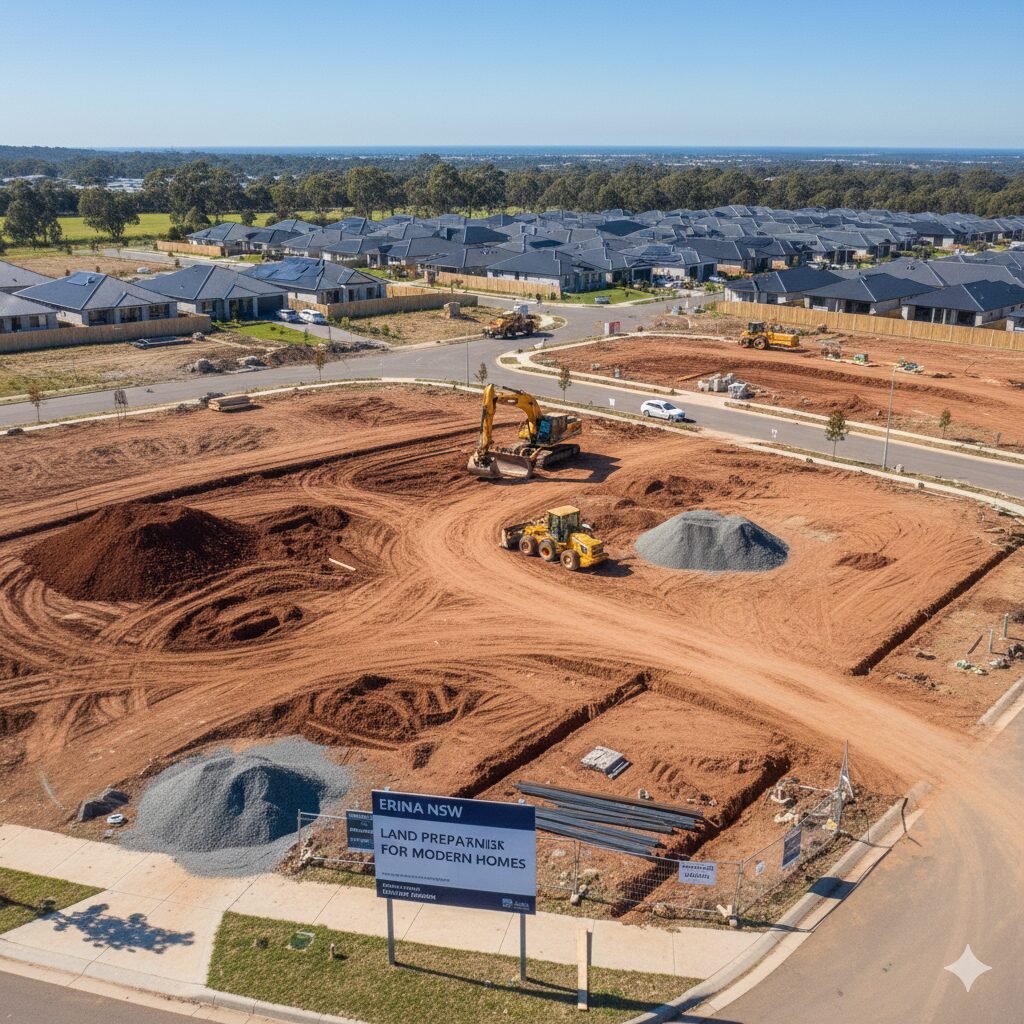
Building your dream home in Erina, New South Wales, involves more than just the construction itself. Before the first brick is laid or frame is erected, your block requires careful preparation—and this is where site costs Erina NSW come into play. These expenses, often underestimated by first-time builders, can significantly impact your overall budget and deserve thorough consideration during your planning phase.
Understanding building site costs, Erina helps you avoid financial surprises and ensures your project starts on solid ground—literally. Many homeowners focus exclusively on the builder’s quote without realising that construction site costs Erina NSW occur before construction even begins. This comprehensive guide will walk you through every aspect of home building site costs Central Coast NSW, empowering you to budget accurately and make informed decisions.
What Are Site Costs?
Site preparation costs Erina refer to all expenses associated with getting your land ready for construction. These costs cover the essential groundwork that transforms raw land into a building-ready platform. Unlike house building costs Erina NSW, which cover the actual structure, site costs address what happens beneath and around your future home.
The distinction matters because most builder contracts focus on construction itself. When you receive a site works costs Erina estimate, you’re looking at a separate category that includes everything from initial surveys to final connections. At Home Choice Australia, we provide professional home development services in Erina NSW, and many builders also provide a separate site cost estimate as an additional document, highlighting that these expenses often fall outside their standard pricing structure.
Land preparation costs Erina can vary dramatically based on your block’s characteristics, making it impossible to apply a one-size-fits-all approach to budgeting.
Typical Site Cost Components for Building in Erina
Soil Testing & Engineering Reports
Every building project in New South Wales begins with understanding what lies beneath your future home. Soil testing cost Erina represents your first essential investment, typically ranging from $800 to $2,500 depending on the complexity of testing required.
Engineers conduct soil classification to determine reactivity levels, which directly influences your foundation design. Reactive clay soil can expand and contract with moisture changes, requiring specialized foundation systems that cost significantly more than standard slabs. The reactive clay soil site costs in coastal regions like Erina can add $5,000 to $20,000 to your budget when deep piering and screw piles become necessary.
These engineering assessments provide critical data about soil reactivity, bearing capacity, and drainage characteristics. Without this information, your builder cannot accurately specify the foundation or piering cost NSW requirements for your home.
Land Clearing & Excavation
Preparing your site for construction involves excavation & earthworks Erina to create a level building platform. This process includes vegetation removal through site clearing, followed by earthworks and cut & fill operations to achieve the required levels.
Costs escalate quickly when dealing with sloping land site costs. A gentle slope might require minimal adjustment, while steep terrain demands extensive earthworks, potentially including slope adjustment across multiple terraces. Expect to pay anywhere from $3,000 for simple clearing on flat land to $30,000 or more for complex excavation & earthworks Erina on challenging blocks.
Machinery access plays a crucial role in determining final costs. Sites with good access allow efficient equipment use, while restricted access requires smaller machinery or additional machinery access preparation, increasing both time and expense. Some properties need temporary access track works constructed simply to bring in excavation equipment.
Rock removal cost Australia adds another variable. Discovering rock during excavation can add $50 to $150 per cubic meter to your budget, depending on hardness and volume. This represents one of the most unpredictable cost influencers in site preparation.
Utility Services & Site Connections
Connecting essential services represents a substantial portion of your overall budget. Service connections cost (water, sewer, power, NBN) varies dramatically based on distance to existing infrastructure and local authority requirements.
Water and sewer connections typically cost between $3,000 and $15,000, depending on whether mains run past your property or require extension. Power connections range from $2,000 to $10,000 for standard installations, while NBN and telecommunication services add another $1,000 to $3,000.
Rural or semi-rural properties face higher expenses when infrastructure requires significant extension. Some blocks in Erina’s outskirts might need hundreds of meters of service trenching, dramatically increasing the service connections cost (water, sewer, power, NBN) to $30,000 or beyond.
Local water authorities and energy providers each have specific connection requirements and fees that contribute to your total site accessibility & machinery hire cost calculations.
Temporary Site Setup
Council regulations and safety standards require specific temporary installations before construction commences. Temporary fencing cost typically ranges from $1,500 to $3,500 for a standard residential block, providing security and clearly defining the construction zone.
Sediment control cost represents another mandatory expense, with erosion control measures required to prevent soil runoff into stormwater systems. These measures might include silt fences, sediment traps, or straw bales, costing between $800 and $2,500 depending on site size and slope.
Additional temporary site setup expenses include portable toilets, construction signage, and site sheds. While individually modest, these costs accumulate to $2,000 to $4,000 for typical projects.
Drainage & Stormwater Works
Effective water management prevents structural damage and satisfies council requirements. Drainage and stormwater works cost encompasses planning for runoff, installing drainage and stormwater setup systems, and ensuring your property manages rainfall appropriately.
Erina’s coastal climate receives substantial rainfall, making drainage and stormwater setup particularly important. Basic systems with surface drains and connection to street infrastructure cost $3,000 to $8,000, while complex installations requiring stormwater detention systems or multiple stormwater pits can reach $15,000 or higher.
Some properties require stormwater detention tanks to control water release rates, adding $4,000 to $10,000 to your budget. Trenches, soak wells, and specialized drainage systems address site-specific challenges that standard installations cannot manage.
Retaining Walls & Special Earthworks
Coastal and elevated blocks frequently require structural support to manage level changes. Retaining wall cost NSW varies with height, length, and engineering complexity, typically ranging from $300 to $900 per linear meter for timber or block walls, and $600 to $1,500 per meter for engineered concrete solutions.
Properties with significant contour challenges may need multiple terraces with corresponding retaining walls at different heights. A comprehensive retaining wall system for a sloping site can easily cost $20,000 to $60,000 or more, representing one of the largest single expenses in site preparation.
Retaining walls require engineering certification and must meet specific standards for drainage, stability, and longevity. These structures fundamentally enable building on otherwise unsuitable terrain, making them essential despite their cost.
Foundations & Substructure Adjustments
Your soil classification directly determines foundation requirements and associated costs. Standard concrete slabs suit stable, non-reactive sites and represent the most economical option. However, reactive soils or poor bearing capacity necessitate alternative approaches.
Deep piering and screw piles provide foundation stability on problematic soils, with costs ranging from $8,000 to $30,000 depending on required depth and number of piers. The class of slab specification—from Class A (stable sites) to Class P (highly reactive sites)—dramatically affects pricing.
Footings and reinforcement requirements increase proportionally with soil challenges. Engineering specifications might call for additional steel reinforcement, deeper footings, or specialized concrete mixes, each adding to your foundation or piering cost NSW total.
Council Fees and Approvals (Specific to NSW)
Building in New South Wales requires navigating specific regulatory frameworks that carry associated costs. Development application fees vary based on your estimated construction value, typically calculated as a percentage with minimum charges.
Construction certificates from private certifiers or council cost between $1,500 and $4,000, depending on project complexity. Engineer sign-offs for structural, geotechnical, and stormwater elements add another $2,000 to $5,000 to your approval expenses.
BASIX certification, mandatory for all new homes in NSW, ensures environmental performance standards are met. This certification costs approximately $200 to $600 but may require design adjustments that create additional architectural fees.
These regulatory requirements, while adding to upfront costs, protect your investment by ensuring compliance with building regulations NSW and proper documentation for future sale or refinancing.
Estimated Site Cost Ranges (Australia Reference)
National data suggests typical site preparation expenses range from $5,000 to $70,000 depending on terrain and soil conditions. This wide variation reflects the diverse challenges Australian builders encounter across different regions and block types.
For Erina and the broader Central Coast region, expect costs to trend toward the middle to upper end of this spectrum. Coastal topography often includes slopes requiring extensive earthworks, while proximity to bushland may trigger environmental compliance requirements.
A straightforward flat block with good soil might see total site preparation around $10,000 to $20,000, while challenging properties with steep slopes, poor soil, and distant services can exceed $80,000. These ranges align with industry averages while accounting for Central Coast specific conditions.
Factors That Increase Site Costs
Terrain & Slope
Steep blocks represent the single greatest cost multiplier for site preparation. Level sites allow straightforward excavation and minimal earthwork, while properties with significant fall require extensive cut and fill operations, multiple retaining walls, and complex drainage solutions.
Soil Type
Clay soils exhibiting high reactivity demand specialized foundations that cost substantially more than standard slabs. Rock excavation requires hydraulic breakers or even controlled blasting, dramatically increasing per-cubic-meter removal costs. Poor bearing capacity necessitates deep piering systems that can double or triple foundation expenses.
Access to Utilities
Distance to mains infrastructure directly impacts connection costs. Properties more than 50 meters from existing services face trenching charges that accumulate quickly. Rural or semi-rural locations may require negotiating with multiple service providers, each with distinct connection policies and pricing structures.
Environmental Requirements
Heritage overlays, significant trees requiring retention, or bushfire zone compliance each add specialized requirements to your project. Tree protection zones limit excavation areas, while bushfire regulations mandate specific ember protection measures and defendable space preparation.
Hidden and Additional Costs to Watch For
Many site works quote Erina documents exclude items that homeowners assume are included. Landscaping typically falls outside standard builder contracts, with basic establishment costing $5,000 to $15,000. Driveways, especially longer rural driveways requiring base preparation and surfacing, add $4,000 to $20,000 depending on length and material choice.
Fencing represents another commonly excluded item, with boundary fencing for a standard block costing $3,000 to $8,000. These elements, while not technically part of site preparation, deserve inclusion in your overall budget planning for site works.
Soil remediation becomes necessary when testing reveals contamination or unsuitable material requiring removal and replacement. Rock removal, when encountered unexpectedly during excavation, can add tens of thousands to your costs if significant volumes exist.
Conservative budget planning includes contingency funds of 10 to 15 percent of your total project value. This buffer protects against cost overruns from unexpected site conditions or scope changes during construction.
How to Budget for Site Costs
Accurate budgeting begins with comprehensive site assessment before committing to your builder contract. Invest in professional soil and contour surveys during your due diligence phase, providing concrete data rather than estimates for foundation requirements and earthwork volumes.
Request detailed fixed price quotations from site preparation contractor Central Coast specialists. A thorough contractor site cost estimate breaks down each component, allowing you to identify potential savings or areas requiring additional budget allocation.
When evaluating builder proposals, specifically ask which items are included versus excluded from their quote. Some builders offer comprehensive packages including site works, while others provide construction-only pricing. Understanding this distinction prevents budget shock when excluded costs emerge.
Engage a quantity surveyor for complex sites or when multiple contractors provide conflicting estimates. Their independent assessment helps you understand reasonable cost expectations and identifies quotes that seem unusually high or suspiciously low.
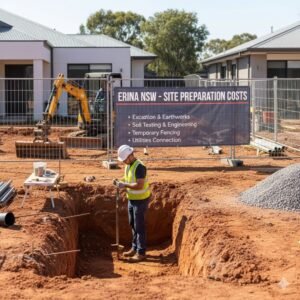
Case Example: Site Cost Breakdown for an Erina Build
Consider two scenarios illustrating how site characteristics affect costs:
Scenario A: Flat Block, Good Soil
- Soil testing and engineering: $1,200
- Minimal excavation and levelling: $4,500
- Service connections (all within 30m): $12,000
- Temporary site setup: $2,500
- Basic drainage works: $4,000
- Standard slab foundation: $8,000
- Council fees and approvals: $3,800
- Total estimated site costs: $36,000
Scenario B: Sloping Block, Reactive Soil
- Comprehensive soil testing: $2,500
- Extensive cut/fill earthworks: $22,000
- Service connections (100m+ trenching): $28,000
- Temporary site setup with erosion control: $4,000
- Complex stormwater system with detention: $12,000
- Retaining walls (two tiers, 20m total): $18,000
- Engineered slab with deep piering: $24,000
- Council fees and approvals: $4,500
- Total estimated site costs: $115,000
These examples illustrate how average costs (Australia / NSW) translate to real projects, with site characteristics creating cost breakdown variations of threefold or more.
Conclusion
Understanding construction site costs Erina NSW empowers you to approach your building project with realistic expectations and adequate budget preparation. While these expenses may seem substantial, they represent essential investments in your home’s structural integrity and long-term performance.
Thorough pre-planning, comprehensive site assessment, and detailed site cost estimate Erina NSW documentation from qualified professionals protect you from unexpected expenses and project delays. Whether you’re building on a straightforward flat site or navigating the challenges of coastal terrain, knowledge of these cost components positions you for success.
At Home Choice Australia, we understand that builders in Erina NSW and surrounding construction contractors Central Coast regions encounter diverse site conditions. Taking time to properly understand and budget for site preparation ensures your building journey progresses smoothly from ground preparation through to final handover.