
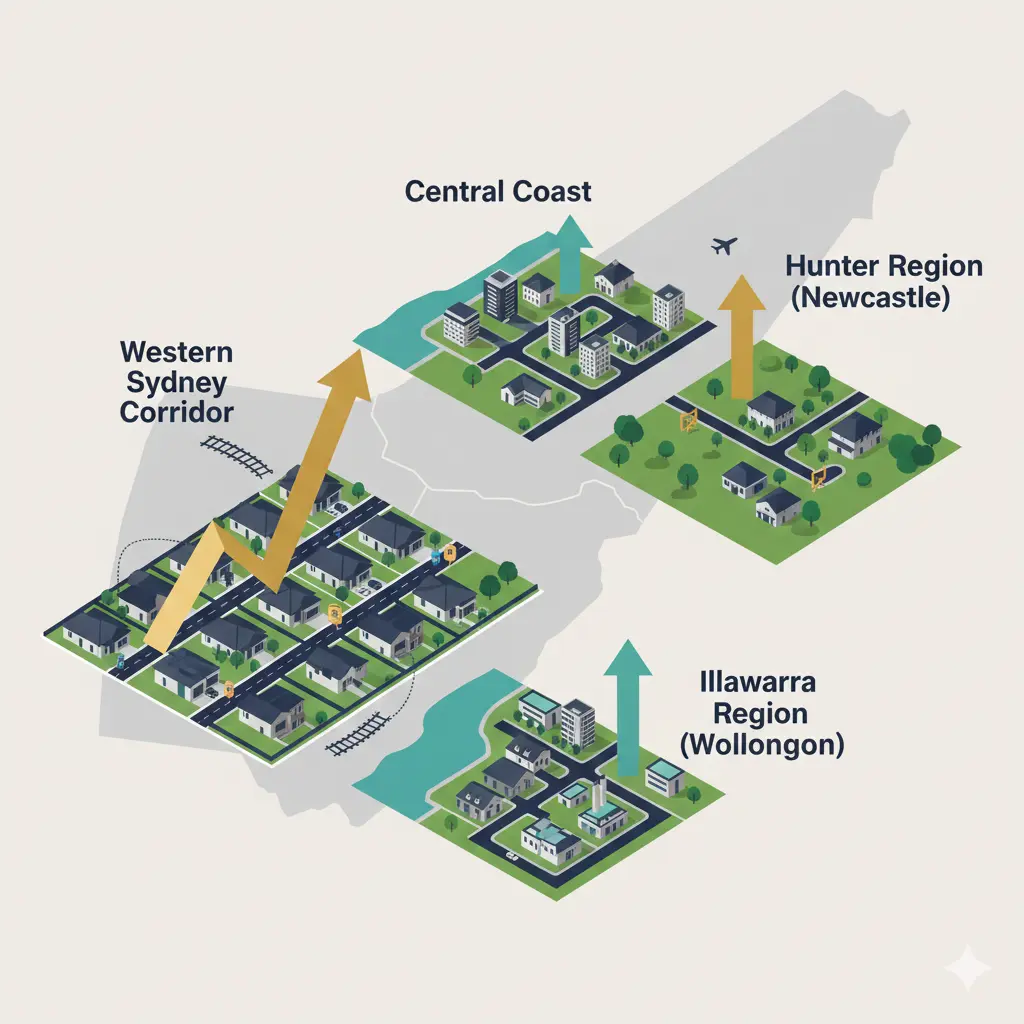
Property investment in New South Wales continues to be one of the most reliable wealth-building strategies in Australia. But in 2026, success isn’t about jumping on the latest hot suburb or following the crowd—it’s about making informed decisions based on genuine market fundamentals.
Whether you’re a first-time investor or expanding your portfolio, this guide will help you understand where to invest, how to choose the right strategy, and whether now is the time to buy, hold, or sell.
Where Should I Invest in Property in 2025?
The best property investment locations in NSW share three critical characteristics that drive long-term success:
Strong population growth – More people means more housing demand, which supports both rental income and capital appreciation.
Major infrastructure or employment hubs – New transport links, business districts, and amenities create sustained property value growth.
Housing undersupply – When demand outstrips supply, prices naturally rise over time.
In 2026, savvy investors are looking beyond the obvious inner-city Sydney markets and discovering exceptional opportunities in outer Sydney growth corridors and high-demand regional areas.
Top NSW Investment Focus Areas for 2026
Sydney Growth Corridors
Western Sydney and South-West Sydney are experiencing a transformation. Suburbs near new transport connections and employment hubs offer something increasingly rare: genuine long-term capital growth potential at relatively accessible price points.
These areas benefit from government investment in infrastructure, new schools, shopping centres, and improved connectivity to the CBD. For investors, this means getting in early on suburbs that will likely see significant appreciation over the next decade.
Central Coast NSW
The Central Coast has emerged as a standout market for property investors. It combines lifestyle appeal with practical commuter access to Sydney, creating strong demand from both renters and buyers.
Rising rental demand across the Central Coast supports steady price growth while offering investors better yields than many comparable Sydney suburbs. The region attracts young families, professionals working remotely, and retirees—providing diverse tenant pools that reduce vacancy risk.
Erina & Surrounding Areas
Erina and nearby Central Coast suburbs represent established investment opportunities with genuine fundamentals. The area features mature infrastructure, major retail hubs, and consistent demand for family housing.
What makes this area particularly attractive is the limited land supply combined with ongoing demand. When working with local property professionals who understand the Central Coast market deeply, investors can identify opportunities that balance immediate rental returns with long-term appreciation.
Regional NSW Growth Centres
Newcastle and the Hunter Region, the Illawarra, and major inland regional hubs are delivering compelling investment metrics. These markets typically offer higher rental yields than Sydney while requiring substantially lower initial capital investment.
Regional centres are benefiting from lifestyle migration trends, with more people choosing to work remotely or relocate entirely from capital cities. This shift is creating sustained rental demand and gradual price appreciation in well-selected regional markets.
Capital Growth vs Rental Yield: Which Strategy Works Best in 2026?
One of the most important decisions you’ll make as a property investor is choosing your primary investment strategy. Both capital growth and rental yield have merit—the right choice depends on your financial goals, timeline, and personal circumstances.
Capital Growth Strategy
A capital growth strategy focuses on long-term wealth accumulation through property value appreciation. You’re essentially building equity that can be accessed later through refinancing or selling.
Best locations for capital growth:
- Sydney growth corridors with planned infrastructure
- Central Coast lifestyle suburbs with supply constraints
- Established areas undergoing significant upgrades
Advantages of this approach: Long-term price appreciation builds substantial wealth over time. As your property value increases, you create equity that can fund additional investments or support your retirement goals.
Considerations: Properties in high-growth areas often deliver lower rental yields initially, meaning you may need to contribute additional funds to cover mortgage payments and expenses. Entry prices are typically higher, requiring more substantial deposits.
Rental Yield Strategy
A rental yield strategy prioritizes immediate cash flow. Your goal is to generate strong weekly rental income that covers—or ideally exceeds—your property expenses.
Best locations for rental yield:
- Regional NSW cities with strong employment
- High-demand rental markets with diverse tenant pools
- Areas with affordable entry prices and solid rental demand
Advantages of this approach: Strong weekly cash flow reduces your holding costs and may even generate positive income from day one. This makes the investment more sustainable and less financially stressful.
Considerations: Some high-yield areas experience slower capital appreciation. While your cash flow may be excellent, your equity growth might be more modest compared to growth-focused markets.
The Balanced Approach for 2026
Smart investors in 2026 are increasingly adopting a blended strategy. Rather than choosing exclusively between growth and yield, they’re targeting suburbs that offer moderate rental returns alongside strong future growth potential.
For example, certain Central Coast suburbs provide respectable rental yields while also benefiting from population growth and infrastructure development. This balanced approach delivers cash flow today while building wealth for tomorrow.
When evaluating investment opportunities, working with experienced real estate professionals can help you identify these balanced opportunities. Home Choice Australia’s approach to property investment focuses on understanding each investor’s unique goals and matching them with properties that align with their long-term strategy.
Best Suburbs to Invest in Australia: 2026 NSW Focus
While investment opportunities exist nationwide, NSW remains a top choice for Australian property investors due to sustained population inflows, economic strength, and diverse market options.
What Makes a Suburb Investment-Worthy in 2026?
Transport infrastructure connectivity – Suburbs near existing or planned train lines, major roads, and public transport consistently outperform. Connectivity to employment centres is crucial for rental demand and long-term value growth.
New development and community amenities – Areas with new housing estates, schools, medical facilities, and retail centres signal growing communities with sustained demand.
Lifestyle and employment balance – Suburbs offering both lifestyle appeal (beaches, parks, recreation) and proximity to employment centres attract diverse tenant demographics and buyers.
Gentrification and renewal – Undervalued suburbs undergoing transformation often present exceptional opportunities for investors who can identify them early.
Sydney, the Central Coast, and selected regional NSW markets consistently feature among Australia’s best investment suburbs because they tick multiple boxes across these criteria.
The 2% Rule Explained (And Does It Still Work in NSW?)
You may have heard experienced investors mention the “2% rule” when evaluating properties. Understanding this rule—and its limitations—is important for making informed investment decisions.
What Is the 2% Rule for Property Investment?
The 2% rule is a traditional property investment guideline suggesting that a property’s weekly rent should equal at least 2% of its purchase price.
Here’s how it works: If you purchase a property for $600,000, the 2% rule suggests it should ideally rent for $12,000 per week to meet the benchmark. Obviously, that’s not realistic in any NSW market. The calculation is actually based on annual yield: weekly rent should be 2% of the purchase price when annualized, which translates to a 1% weekly rent figure.
Corrected example: A $600,000 property should rent for approximately $1,154 per week to achieve a 10% gross rental yield, which is what the 2% monthly rule approximates (2% of purchase price per month equals roughly 24% annually before expenses).
In practice, the rule is more commonly stated as: monthly rent should equal 1% of the purchase price, which translates to a 12% gross annual yield.
Does the 2% Rule Still Work in NSW?
In most parts of NSW—particularly Sydney, the Central Coast, and established regional centres—achieving yields that meet traditional 2% or even 1% rules is extremely challenging due to high property prices relative to rents.
But here’s the critical insight: This doesn’t mean these markets represent poor investments.
Why the 2% Rule Is Less Relevant in Modern NSW Investing
Strong capital growth compensates for lower yields – A property delivering 4% rental yield but 8% annual capital growth substantially outperforms a property with 7% yield but 2% capital growth over time.
Rental demand remains exceptionally high – NSW’s ongoing housing shortage means quality properties rarely sit vacant, providing reliable income even if yields appear modest on paper.
Long-term equity gains often outperform cash-flow metrics – Building equity through capital appreciation creates wealth that can be accessed through refinancing, supporting portfolio expansion or future financial security.
Tax benefits and leverage effects – Australian tax structures and the power of leverage mean that even modest-yielding properties can deliver excellent overall returns when all factors are considered.
What Experienced NSW Investors Prioritize Instead
Rather than fixating on strict yield rules, successful investors in 2026 focus on:
- Population growth trends – Are more people moving to this area?
- Rental demand strength – How quickly do properties rent, and how stable are tenancies?
- Infrastructure investment – What government and private investment is occurring?
- Long-term appreciation potential – What does the 5-10 year outlook suggest?
These fundamentals provide a more comprehensive picture of investment quality than yield percentages alone.
Should You Sell or Hold Property in 2026?
If you’re a current property owner considering your options, the sell-or-hold decision is one of the most significant you’ll face this year.
Should I Sell My House Now or Wait?
For most NSW property owners, holding property through 2026 and beyond is typically the stronger strategy, unless specific personal circumstances necessitate selling.
Compelling Reasons to Hold in 2026
Ongoing housing shortages – NSW continues to experience significant undersupply relative to population growth. This fundamental imbalance supports sustained price growth across most markets.
Continued population growth – Both interstate and overseas migration are driving increased housing demand throughout NSW, particularly in Sydney and surrounding regions.
Strong rental demand – Vacancy rates remain low across most NSW markets, meaning investment properties continue generating reliable income while appreciating in value.
Expected long-term price growth – Despite short-term market fluctuations, long-term trends strongly favor property owners who maintain their holdings through market cycles.
Transaction costs and tax implications – Selling property involves substantial costs (agent fees, legal expenses, potential capital gains tax) that can significantly impact your net proceeds.
When Selling Might Make Strategic Sense
You need capital for development or reinvestment – If you’ve identified a substantially better investment opportunity or wish to develop property, selling to access capital may be worthwhile.
Your suburb has peaked or lacks future growth drivers – Some areas experience rapid growth followed by stagnation. If your property is in a market with limited future catalysts, redeploying capital elsewhere might be prudent.
Financial restructuring is necessary – Changing personal circumstances, debt reduction goals, or portfolio rebalancing might make selling appropriate despite general market conditions.
Lifestyle changes require relocation – Sometimes life circumstances simply require change, and that’s perfectly valid even in a strong property market.
The Hold Strategy in Practice
In growth areas like Western Sydney, Erina and the Central Coast, and Newcastle, holding quality property typically delivers superior long-term returns compared to selling early and trying to time the market.
Property investment is fundamentally a long-term wealth strategy. The most successful investors understand that building substantial wealth through property requires patience, discipline, and a focus on fundamentals rather than short-term market movements.
Consulting with knowledgeable real estate professionals can help you evaluate your specific situation objectively. Whether you’re considering selling, holding, or acquiring additional properties, getting expert perspective on your local market conditions and personal circumstances helps ensure you make decisions aligned with your long-term financial goals.
Property Investment Strategy Summary: NSW in 2026
As we’ve explored throughout this guide, successful property investment in 2026 requires moving beyond outdated rules and market hype. Instead, focus on these core principles:
Look beyond obvious locations – Growth corridors and emerging markets often provide better opportunities than established inner-city suburbs with limited upside.
Balance your investment objectives – Consider both immediate cash flow and long-term appreciation rather than focusing exclusively on one metric.
Question traditional rules – Guidelines like the 2% rule have limited applicability in modern NSW markets. Focus instead on fundamental demand drivers.
Prioritize genuine growth factors – Population growth, infrastructure investment, and housing supply constraints are more important than any single yield percentage.
Think long-term – In strong NSW markets, holding quality property consistently outperforms short-term trading strategies.
The NSW property market in 2026 offers genuine opportunities for investors who approach it strategically. Whether you’re exploring Sydney growth corridors, considering Central Coast investments, or evaluating regional options, success comes from understanding local market dynamics and aligning your investment choices with your personal financial goals.
Making informed property investment decisions often benefits from professional guidance. Home Choice Australia works with investors throughout NSW, providing insights into local markets and helping match investment strategies with individual goals. Understanding your market deeply—whether that’s the infrastructure transformation in Western Sydney or the lifestyle-driven demand on the Central Coast—makes the difference between average and exceptional investment outcomes.
Property investment isn’t about finding the “perfect” suburb or timing the market flawlessly. It’s about making sound decisions based on solid fundamentals, maintaining a long-term perspective, and building wealth steadily over time. With the right approach and support, 2025 can be an excellent year to grow your property portfolio in NSW.