
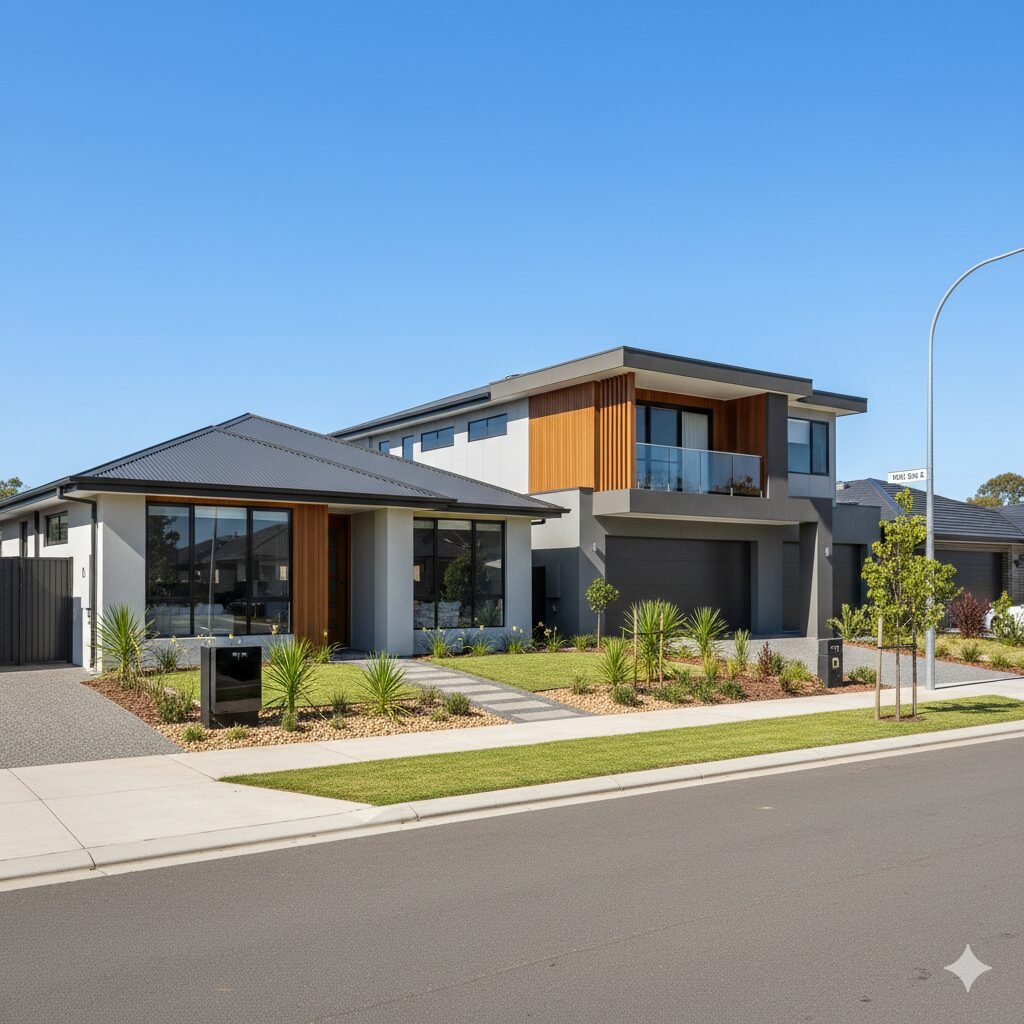
Choosing between a single storey vs double storey house is one of the most important decisions you’ll make when building your dream home. This choice affects everything from your upfront construction costs to your daily lifestyle, energy efficiency ratings, and even the resale value in NSW property market.
In New South Wales, particularly in areas like Erina and across the Central Coast, the debate between single storey or double storey home Australia options has become increasingly relevant as land size and frontage availability changes and property prices continue to rise. Whether you’re working with a compact urban block or a generous suburban plot, understanding the differences between these two popular residential home design Erina styles will help you make an informed decision.
This comprehensive guide covers the cost of single storey vs double storey house construction, lifestyle considerations, building regulations NSW requirements, and practical advice to help you determine the best house design single vs double storey for your specific situation. At Home Choice Australia, we specialize in helping families navigate these important decisions through our home development services, finance solutions, and prefabricated building options.
What Is a Single Storey House?
A single storey house is a residential building where all living spaces, bedrooms, bathrooms, and common areas are located on one level, with no stairs required for daily movement. This single level vs double level home design has been a traditional favorite across Australian suburbs for decades.
In NSW residential building options, single storey home design Australia typically features an open floor plan layout with bedrooms branching off a central hallway, living areas that flow naturally into outdoor spaces, and direct access to the backyard. These homes are particularly common on larger suburban blocks where land availability isn’t a constraint.
Single storey houses are ideal for aging in place considerations, making them popular among families planning for long-term living. The absence of stairs means better accessibility for elderly family members, young children, and anyone with mobility considerations. In regions like Erina NSW, where many families value the indoor-outdoor lifestyle, single storey designs seamlessly integrate with outdoor entertaining areas and garden spaces.
What Is a Double Storey House?
A double storey house features living spaces distributed across two floors, typically with common areas like the kitchen, living room, and dining spaces on the ground floor, while bedrooms and private spaces are located upstairs. This two storey house vs one storey house distinction fundamentally changes how you utilize your building footprint.
Structurally, double storey home design NSW requires additional structural engineering considerations, including load-bearing calculations, staircase safety requirements, and ceiling height regulations. These homes must meet specific building regulations NSW standards regarding fire egress, balustrade heights, and structural integrity.
Double storey homes have become increasingly popular in high-density areas like Sydney, Newcastle, and Wollongong where land costs are premium. On smaller blocks, a double storey design allows you to maximize living space without sacrificing valuable backyard area. This makes them particularly suitable for narrow urban blocks where a single storey footprint would consume the entire site, leaving little room for outdoor living.
The vertical design also creates natural privacy and separation of spaces, with private sleeping quarters elevated away from the busier ground-level living areas—a feature many modern families appreciate in house design comparison Australia discussions.
Pros and Cons: Side-by-Side Comparison
Single Storey House Advantages and Disadvantages
Advantages:
- Superior Accessibility: Single storey houses eliminate stairs entirely, making daily life safer and easier for children, elderly parents, and anyone with mobility challenges. This aging in place benefit means your home can adapt as your family’s needs evolve.
- Lower Construction Costs: Building a single storey is typically cheaper to build than an equivalent double storey home. You’ll save on structural engineering requirements, reduced scaffolding needs, and simpler plumbing and electrical installations.
- Faster Construction Timeline: Without the complexity of second-floor framing and staircase installation, single storey construction generally progresses more quickly, potentially saving on labor costs.
- Easier Maintenance and Cleaning: All gutters, windows, and exterior surfaces are easily accessible from ground level, reducing ongoing maintenance costs. Interior cleaning is also simpler without navigating stairs.
- Better Natural Ventilation: Single level designs often achieve superior natural light and ventilation through strategic window placement and cross-breezes, contributing to better energy efficiency ratings in many floor plan layouts.
- Safer for Families: Eliminating staircase-related accidents is a significant safety advantage, especially for households with young children or elderly residents.
Disadvantages:
- Larger Land Requirements: To achieve the same living space as a double storey, a single storey house requires a larger building footprint, which means you need more land size and frontage. On expensive blocks, this translates to significantly higher land costs.
- Reduced Backyard Space: The larger footprint consumes more of your block, leaving less room for outdoor entertaining, pools, or gardens—important considerations for NSW’s outdoor lifestyle.
- Limited Privacy Separation: With all bedrooms on one level, there’s less natural privacy and separation of spaces between living areas and sleeping quarters. Noise transfer between rooms can be more noticeable.
- Fewer Views: Single storey homes don’t capture elevated views or breezes that upper-floor rooms might enjoy, which can be a disadvantage on sloping land or in scenic locations.
Double Storey House Pros and Cons
Advantages:
- Maximizes Small Blocks: Double storey designs are perfect for smaller blocks where land is limited. You can achieve substantial living space while preserving valuable backyard area for pools, entertaining, and gardens.
- Better Privacy and Separation: The vertical layout creates natural zoning, with private sleeping areas upstairs completely separated from ground-floor entertaining spaces. This reduces noise transfer between floors in terms of living noise versus sleeping areas.
- Potential for Views and Light: Upper-floor bedrooms can capture views, breezes, and elevated natural light that ground-level rooms miss. This is particularly valuable in bushfire and flood zoning NSW areas where elevation provides additional benefits.
- Often Higher Resale Value: In high-demand markets across NSW, particularly in Sydney and coastal areas, double storey homes frequently command premium prices due to their efficient use of valuable land.
- More Design Flexibility: Two levels allow for creative site orientation and floor plan solutions, especially on sloping land considerations where the terrain naturally suggests a split-level approach.
Disadvantages:
- Higher Construction Costs: The cost of building a double storey is typically 10-20% more expensive than a comparable single storey due to structural engineering requirements, more complex foundations, staircase installation, and additional scaffolding needs.
- Accessibility Challenges: Stairs pose difficulties for elderly residents, young children, people with injuries, and those planning for aging in place. This can limit your home’s long-term suitability.
- Higher Maintenance Costs: Cleaning upper-floor windows, maintaining gutters, and exterior painting require ladders or professional services, increasing ongoing maintenance costs.
- Energy Efficiency Challenges: Heat naturally rises, making upper floors hotter in summer and potentially making it harder to heat and cool the home evenly. This can increase energy bills despite modern energy efficiency ratings standards.
- More Complex Cleaning: Carrying vacuum cleaners and cleaning supplies upstairs daily adds physical effort to household maintenance.
- Council Approval Complexity: Double storey homes face stricter council approval NSW processes, particularly regarding overshadowing neighbors, privacy concerns from elevated windows, and compliance with local height restrictions.
How Much Does It Cost? (Australia / NSW Focus)
Understanding the cost of single storey vs double storey house construction in Australia requires examining several financial factors beyond just the building contract.
Construction Costs:
In 2026, building a single storey home in NSW typically costs between $1,800 to $2,500 per square meter for a standard project home through home builders in Erina NSW and across the region. The same home built as a double storey usually ranges from $2,000 to $2,800 per square meter—approximately 10-20% more expensive due to additional structural requirements.
For a 200-square-meter home, this difference might mean $40,000 to $60,000 in additional construction costs Australia for double storey construction. These figures can vary based on site conditions, design complexity, and builder selection.
Land Cost Implications:
However, the equation changes dramatically when you factor in land costs. In areas like Erina home development zones and across the Central Coast house designs market, land prices can exceed $500 to $1,000 per square meter in desirable locations.
If a single storey home requires a 400-square-meter block versus a double storey on a 250-square-meter block, the land savings alone could be $75,000 to $150,000—far exceeding the additional building cost of going double storey. This is why double storey homes dominate in high-density urban markets where land is premium.
Operational and Maintenance Costs:
Beyond construction, ongoing costs differ between designs. Single storey homes often prove cheaper to maintain, with accessible gutters, windows, and roofing reducing professional service needs. Energy efficiency ratings can favor single storey designs in temperate climates, though modern insulation and HVAC systems can minimize these differences.
Double storey homes may face higher heating and cooling costs due to thermal stratification, where heat concentrates on upper floors. Quality insulation and zoned climate control systems help manage this but add to initial costs.
At Home Choice Australia, our finance services can help you model the total cost of ownership—including land, construction, and ongoing expenses—to determine which option delivers better long-term value for your budget and circumstances.
Lifestyle and Practical Considerations
Choosing between single storey vs double storey homes Australia isn’t purely financial—your daily lifestyle and family composition play crucial roles.
Family Composition and Life Stage:
Families with young children often appreciate single storey living for safety and supervision ease. Parents can monitor children throughout the home without constant stair navigation, and bedtime routines are simpler when everyone sleeps on one level.
However, families with teenagers often value the privacy and separation of spaces that double storey designs provide. Upstairs bedrooms create a natural teenage zone, while parents maintain some separation from late-night activities.
For multi-generational households caring for elderly parents, single storey designs excel in accessibility, though double storey homes with ground-floor master suites can work if stairs aren’t required for essential daily activities.
Outdoor Living in NSW:
The NSW lifestyle emphasizes outdoor entertaining, and your house design significantly impacts backyard usability. Single storey homes with large footprints may leave limited yard space, while double storey designs preserve more outdoor area for pools, gardens, and entertaining spaces.
In house construction Erina NSW and throughout the Central Coast, where outdoor living is highly valued, this backyard consideration often tips decisions toward double storey designs on smaller blocks.
Regional vs Metro Preferences:
In metropolitan Sydney and Newcastle, where new home design Erina blocks are increasingly compact, double storey homes dominate new constructions. Buyers accept stairs as a trade-off for better land value and larger backyards.
In regional NSW, where land remains more affordable and blocks are larger, single storey designs remain popular. The traditional Australian preference for single-level living persists where space permits.
Future Needs and Flexibility:
Consider your 10-20 year plan. Will aging in place matter? Will children leave home, changing your space needs? Single storey homes offer better long-term flexibility for changing mobility needs, while double storey homes may require eventual downsizing or modifications.
NSW-Specific Planning & Council Considerations
Building either single storey or double storey homes in NSW requires navigating specific planning and regulatory frameworks.
Council Approval NSW Requirements:
Local councils assess development applications based on building regulations NSW codes, local zoning requirements, and neighborhood character considerations. Double storey applications face additional scrutiny regarding:
- Overshadowing: Upper floors can cast shadows on neighboring properties, affecting their solar access and natural light. Council zoning requirements typically mandate shadow diagrams showing winter solstice impacts.
- Privacy: Elevated windows may overlook neighboring yards and windows. Council approval often requires privacy screens, window placement adjustments, or frosted glass in sensitive locations.
- Height Restrictions: Council zoning requirements may limit building heights in certain zones, potentially restricting double storey designs or requiring pitch roof reductions.
- Neighborhood Character: Some established neighborhoods have character provisions favoring single storey development to maintain streetscape consistency.
Site-Specific Considerations:
Site orientation significantly affects both design types. North-facing blocks benefit single storey designs with better solar access throughout, while sloping land considerations often favor split or double storey designs that work with the terrain rather than requiring extensive earthworks.
In bushfire and flood zoning NSW areas, elevation requirements may necessitate raised floor levels, which can integrate naturally with double storey designs but create accessibility challenges for single storey homes.
At Home Choice Australia, our development team assists with council approval NSW processes, ensuring your chosen design complies with all regulatory requirements before construction begins.
Disadvantages of Split-Level Houses (Related Option)
While considering single storey vs double storey house Erina NSW options, some builders propose split-level designs as a compromise—but these come with distinct disadvantages worth understanding.
What Is a Split-Level House?
A split-level house features multiple floor levels (typically three or four) separated by short staircases, often half a story apart. Living areas might be on one level, sleeping areas up half a flight, and garages or recreation rooms down half a flight.
Common Drawbacks:
Split-level designs present several challenges that often make them less popular in house design comparison Australia:
- Complex Floor Plan Layout: The multiple levels create confusing layouts, particularly for visitors and young children. The fragmented space can feel disconnected rather than cohesive.
- Accessibility Issues: While stairs between levels are shorter than full-story runs, they’re still problematic for elderly residents, young children, and anyone with mobility challenges. You still can’t avoid stairs throughout daily living.
- Resale Value Concerns: Split-level homes typically have lower resale value in NSW property market conditions compared to conventional single or double storey designs. They appeal to a narrower buyer pool.
- Difficult Renovations: Modifying split-level homes is structurally complex and expensive. The multiple floor levels complicate additions, reconfiguration, and accessibility improvements.
- HVAC Challenges: Heating and cooling split-level homes efficiently is difficult, with multiple zones requiring separate climate control systems, affecting energy efficiency ratings.
For most families building a home in Erina NSW and across the region, conventional single or double storey designs offer better long-term value, resale appeal, and daily functionality than split-level alternatives.
What Is the Cheapest House Style to Build?
When considering what is the cheapest house style to build in NSW, several factors determine the most economical approach for your specific situation.
Generally Most Economical:
Single storey homes typically represent the cheapest option for construction costs Australia on a per-square-meter basis. Their simpler structural engineering, single-level plumbing and electrical systems, and reduced scaffolding requirements minimize building expenses.
A basic rectangular single storey design with a simple roofline, minimal external corners, and straightforward floor plan layout will almost always be the most affordable building option in pure construction terms.
When Double Storey Becomes Cost-Effective:
However, what is the cheapest house style to build in NSW must account for total costs including land:
- Expensive Land: On premium blocks where land exceeds $800-$1,000 per square meter, the land savings from a smaller double storey footprint often outweigh the higher construction costs.
- Small Blocks: On compact blocks under 300 square meters, single storey designs may not be practical for desired living space, making double storey the only viable option.
- High-Density Zones: In areas where council zoning requirements favor compact development, double storey designs may be the only approved option.
Situations Favoring Each Design:
For custom home builders Central Coast NSW, the most cost-effective approach depends on your specific circumstances:
- Choose Single Storey When: You have affordable land over 400 square meters, prefer accessibility, and want to minimize construction costs and maintenance costs long-term.
- Choose Double Storey When: Land is expensive, your block is under 350 square meters, you need maximum living space with a decent backyard, and resale value in your area favors two-story designs.
Prefabricated Options:
At Home Choice Australia, our prefabricated building services offer cost advantages for both single and double storey designs. Prefabricated construction reduces on-site labor, construction timeline, and weather-related delays—potentially saving 10-15% compared to traditional building methods while maintaining quality standards.
Resale Value & Market Trends in NSW
Understanding how single storey vs double storey house New South Wales designs perform in resale situations helps inform your long-term investment decision.
Current Market Preferences:
Across the NSW property market, buyer preferences vary significantly by location and demographic:
In metropolitan Sydney, particularly in high-density suburbs, double storey homes command premium prices due to efficient land use. Buyers in these markets expect two-story designs and factor them into valuation expectations. A well-designed double storey on a modest block often outperforms a single storey on the same land.
On the Central Coast house designs market, including Erina and surrounding areas, preferences are more mixed. Families with young children and retirees often specifically seek single storey homes for accessibility and lifestyle, sometimes paying premiums for single-level living on appropriately sized blocks.
In established inner-city suburbs with character housing, single storey homes—particularly those preserving period features—may command premiums due to scarcity and heritage appeal.
Design Features Affecting Resale:
Beyond single versus double storey, specific design elements significantly impact resale value in NSW property market:
- Natural Light and Ventilation: Homes with excellent solar access, cross-ventilation, and bright interiors sell faster and for higher prices regardless of configuration.
- Floor Plan Layout: Open-plan living spaces that flow to outdoor entertaining areas remain highly desirable. Both single and double storey homes can achieve this with good design.
- Master Suite Quality: Generous master bedrooms with ensuites and walk-in robes are expected in modern homes. In double storey designs, ground-floor master suites can appeal to aging buyers.
- Outdoor Space: Usable backyard area significantly affects family buyer appeal. Double storey homes that preserve outdoor space often outperform cramped single storey alternatives on small blocks.
- Energy Efficiency: Modern buyers increasingly value sustainability, energy efficiency ratings, and reduced operating costs. Well-insulated, properly oriented homes of either configuration command premiums.
Long-Term Value Considerations:
Research from Australian property markets suggests double storey homes in high-demand urban areas tend to appreciate faster due to land efficiency, while single storey homes on larger blocks appreciate more in family-oriented suburban areas where land and accessibility are valued.
The best house design single vs double storey for resale in your specific location depends on local buyer demographics, typical block sizes, and neighborhood character. Consulting with custom home builders Central Coast NSW or local real estate agents provides market-specific insights.
How to Decide: Checklist
Use this practical checklist to evaluate which design suits your situation:
Budget Assessment:
- [ ] What is my total budget including land and construction?
- [ ] Have I compared total costs (land + building) for both options?
- [ ] Can I access appropriate finance for my preferred option? (Home Choice Australia offers finance services to help)
- [ ] Have I factored in ongoing maintenance costs and energy bills?
Land and Site:
- [ ] What is my block size and frontage?
- [ ] Does my land have sloping land considerations that favor one design?
- [ ] What are the council zoning requirements and building regulations NSW for my site?
- [ ] Will council approval NSW be easier for single or double storey?
Family Needs:
- [ ] What is my current family composition (young children, teenagers, elderly parents)?
- [ ] Do I have any accessibility requirements now or foreseeable in future?
- [ ] Is aging in place important for my long-term plans?
- [ ] How important is privacy and separation of spaces for my household?
Lifestyle Preferences:
- [ ] How important is outdoor living and backyard space?
- [ ] Do I prioritize single-level convenience or maximum indoor space?
- [ ] Am I comfortable with daily stair navigation?
- [ ] Do I prefer ground-level living for safety and accessibility?
Long-Term Plans:
- [ ] Do I plan to stay in this home for 10+ years?
- [ ] How might my family needs change (aging, children leaving)?
- [ ] Which design has better resale value in NSW property market for my area?
- [ ] Does my neighborhood favor single or double storey for resale appeal?
Practical Considerations:
- [ ] Can I maintain a double storey home (gutters, windows, exterior)?
- [ ] Are there site orientation advantages for solar access?
- [ ] Do local house construction Erina NSW builders have experience with my preferred design?
Working through this checklist helps clarify which design aligns with your priorities. At Home Choice Australia, we provide personalized consultations considering all these factors, helping you make an informed decision based on your unique circumstances.
Conclusion
The choice between a single storey vs double storey house ultimately depends on your individual circumstances rather than one universally superior option. Both single storey and double storey house designs offer distinct advantages suited to different situations.
Single storey homes excel in accessibility, maintenance simplicity, and construction cost efficiency, making them ideal for larger blocks, families prioritizing aging in place, and those who value single-level convenience. Their straightforward floor plan layout and easier natural light and ventilation often create comfortable, livable spaces perfect for NSW’s climate.
Double storey homes maximize land efficiency, preserve valuable backyard space, and create natural privacy and separation of spaces, making them ideal for smaller blocks, high-density areas, and families needing maximum living space on limited land. In areas with premium land costs, the efficiency of double storey designs often delivers better overall value despite higher construction costs.
When evaluating single storey vs double storey homes Australia options, consider your total budget including land, your block size and site conditions, your family composition and lifestyle needs, and your long-term plans. Neither design is inherently better—the right choice depends on how well each option aligns with your priorities, budget, and circumstances.
For building a home in Erina NSW and throughout New South Wales, working with experienced home builders in Erina NSW who understand local council approval NSW requirements, building regulations NSW, and regional market conditions ensures your chosen design meets all practical and regulatory requirements.
Ready to explore your options? At Home Choice Australia, we specialize in helping families navigate these important decisions. Our comprehensive services include:
- Home Development Services: Expert guidance on site selection, design choice, and development planning
- Finance Solutions: Tailored financing options to make your dream home affordable
- Prefabricated Building Options: Cost-effective, quality construction for both single and double storey designs
Contact Home Choice Australia today for a personalized consultation. Our experienced team will help you evaluate your specific situation, understand your local market, and choose the best house design single vs double storey for your needs. Let us turn your vision of the perfect home into reality, whether that’s a spacious single storey sanctuary or an efficient double storey family home.