
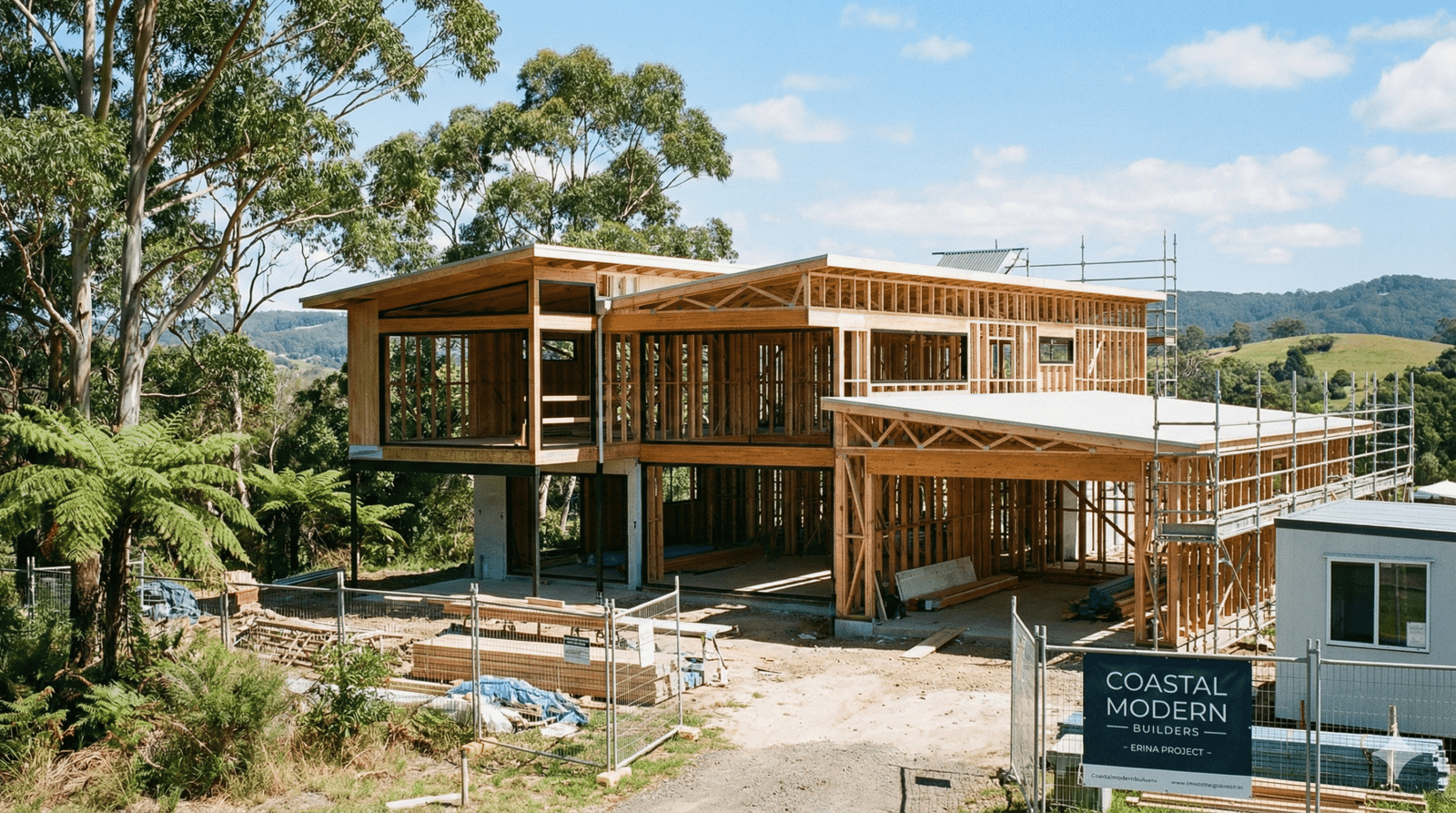
The Central Coast housing market is seeing a significant shift toward modular homes, and it’s easy to understand why. Factory-built housing delivers speed, quality control, and cost transparency that traditional construction methods often struggle to match. For families and investors across NSW, modular construction offers a practical pathway to homeownership without compromising on design or durability.
This guide walks you through everything you need to know before choosing a modular home in the Central Coast, NSW, Australia. You’ll learn about local council regulations, site preparation requirements, how to compare modular home builders in NSW, cost breakdowns, and the specific considerations that matter for Central Coast families. Whether you’re exploring affordable modular homes in NSW or looking for custom modular homes Central Coast, this buyer’s guide will help you make an informed decision.
What Makes the Central Coast Unique for Modular Housing
The Central Coast region sits between Sydney and Newcastle, encompassing council areas from Wyong to Gosford. This location brings specific advantages and challenges for anyone considering modular home construction NSW.
The coastal climate means you’ll need weather-resistant materials that can handle salt spray and humidity. Many blocks feature sloping terrain, which affects site preparation requirements and delivery logistics. Bushfire zoning (BAL rating) applies to several inland areas, while coastal properties may face flood overlay considerations.
The good news? The Central Coast hosts several prefabricated home specialists Central Coast with factory facilities and display centres nearby. This proximity makes it easier to inspect quality firsthand, meet builders face-to-face, and reduce transport costs compared to bringing modules from interstate.
Why Choose Modular Homes for Your Central Coast Property?
Modular home design Central Coast has evolved dramatically. Today’s prefab homes NSW offer three compelling advantages over traditional building methods.
Speed and certainty top the list. While weather delays can stretch conventional builds by months, off-site construction happens in controlled factory conditions. Your modules are built simultaneously with site preparation, cutting overall timelines significantly. Most modular home companies Central Coast can complete factory construction in 12-16 weeks.
Quality assurance inspection occurs at multiple stages within the factory environment. Unlike traditional homes where trades work in varying weather, modern modular homes benefit from consistent conditions and systematic quality checks. Structural integrity is tested before modules leave the factory.
Design flexibility surprises many first-time buyers. You’re not limited to cookie-cutter layouts. Best modular homes Australia now include everything from compact two-bedroom designs to sprawling family estates with smart home features. Standard plans offer the most affordable modular homes NSW pricing, while custom design options let you tailor floor plans to your exact specifications.
Fixed-price contracts are another significant benefit. Unlike cost-plus traditional builds where variations accumulate, turnkey modular solutions provide cost transparency from day one.
Step-by-Step: How to Choose Your Ideal Modular Home
Define Your Needs and Budget First
Before browsing modular home floor plans Central Coast, get clear on your requirements. How many bedrooms do you need today, and what about in five years? Are you planning to age in place, or might this become a rental property? Do you want modern home layouts with open-plan living, or something more traditional?
Your budget must extend beyond the base price advertised by modular home builders NSW. Include these essential items: site preparation, foundation footings, council fees and approvals, service connections (water, sewer, electricity, gas), transport and crane hire, landscaping, and a 10-15% contingency for unexpected costs.
Many Central Coast families discover their total investment runs 30-40% higher than the advertised module price once all site-related expenses are factored in.
Check Site Suitability Before You Shop
This step saves thousands in surprises later. Conduct a soil test through a geotechnical engineer—the results determine your footing design and cost. Order a contour survey to understand slope and drainage patterns.
Assess delivery access carefully. Can a semi-trailer and crane reach your building envelope? You’ll need adequate turning circles and overhead clearance. Council regulations often require road permits for oversized loads.
Check your property’s bushfire and flood zoning through local council planning certificates. Central Coast properties near bushland may require BAL-rated construction with ember guards and specific cladding. Coastal blocks might need elevated floor levels.
Sloping sites are common across the region. Steep gradients increase retaining wall costs and complicate module placement. Some sustainable modular homes Australia builders specialise in challenging terrain—seek them out if your block has significant fall.
Coastal wind loading is another local consideration. Ensure your chosen design meets structural requirements for the Central Coast’s exposed conditions.
Understand NSW Regulatory Requirements
Every new home in NSW must comply with BASIX certification and achieve minimum NatHERS ratings for energy efficiency. BASIX covers water and thermal performance—your builder should handle this documentation.
Ask potential builders: “Do you include BASIX certificates and NatHERS assessments in your price, or are these my responsibility?” The answer reveals whether they offer true turnkey solutions or expect you to coordinate separately.
Building compliance NSW involves development approval (DA) or complying development pathways. Some modular home construction NSW projects qualify for faster complying development if they meet specific criteria. Clarify who lodges applications—experienced modular home companies Central Coast typically manage this process.
Home warranty insurance NSW is mandatory for residential building work over $20,000. Verify your builder carries appropriate cover before signing contracts.
Compare Builders and Manufacturers Thoroughly
Not all modular housing Central Coast providers deliver the same value or service. Start by identifying builders with demonstrated local experience. Have they completed projects in your council area? Can they show you case studies from similar sites?
Arrange factory visits wherever possible. Seeing modules during construction reveals build quality and prefabricated building materials far better than brochures. Many best modular home builders near Central Coast Australia operate display centres where you can walk through completed homes.
Ask for client references and follow up with phone calls. What was their experience with contract variations? How did the builder handle site challenges? Was the timeline met?
Distinguish between supply-only manufacturers and turnkey providers. Supply-only means you coordinate site works, council approvals, and installation separately—feasible if you’re experienced, but risky for first-timers. Turnkey offerings bundle everything into one contract with a single point of accountability.
Verify business credentials: current ABN, builder’s licence, insurance coverage, and membership in industry bodies like HIA.
Scrutinise Contracts, Pricing and Inclusions
Fixed-price contracts protect you from cost blowouts during factory construction. Ensure your contract clearly separates what’s included versus excluded.
Request an itemised quote covering: base module construction, transport from factory to site, crane hire and placement, temporary site facilities, footing preparation and slab (or piers), plumbing and electrical rough-in and connections, BASIX and NatHERS documentation, council application fees, and warranty terms.
Construction timelines should specify factory production duration and site installation windows. Staged payment schedule must align with work milestones—never pay the full amount upfront.
Compare how different modular home prices Central Coast stack up once you account for all inclusions. A lower base price might exclude items that competitors bundle, making the total cost higher.
Understanding what to look for in a modular home builder NSW comes down to transparency. Reputable builders provide detailed documentation and answer questions patiently.
Explore Design, Customisation and Finishes
Modern modular homes NSW range from standard production models to fully customised creations. Standard plans cost less because moulds and processes are established. Customisation becomes expensive when you alter structural elements or module dimensions.
Easy modifications include internal finishes, fixtures, colour selections, and appliance choices. More complex changes—moving load-bearing walls, altering roof lines, adding extra windows—require engineering reassessment and increase costs.
For Central Coast conditions, specify materials suited to coastal environments. Use corrosion-resistant fixtures in bathrooms and kitchens. Select cladding that withstands salt air without deteriorating. Quality powder-coated aluminium windows outlast cheaper alternatives in seaside locations.
Eco-friendly modular housing options include solar-ready modular design with pre-wired roof spaces, rainwater tank plumbing, and energy-star rated homes with superior insulation. These features cost more initially but reduce running expenses for decades.
Plan Site Works, Transport and Installation Logistics
Delivery day represents the most critical 48 hours of your project. Modules travel from factory to site on low-loader trucks—sometimes multiple trips if your design spans several modules.
Crane lifts require careful choreography. Operators need clear access, stable ground, and overhead clearance from power lines and trees. Your builder should conduct a site inspection months before delivery to identify potential obstacles.
Road permits from councils and transport authorities take weeks to arrange for oversized loads. Factor this into your timeline expectations.
Hillside properties demand extra attention. Retaining walls must be completed before module delivery. Access roads might need temporary strengthening. Some customisable modular home packages in NSW include engineering for difficult sites, while others charge this as a variation.
Weather delays occasionally postpone crane lifts—high winds make module placement dangerous. Build buffer time into your schedule rather than booking removalists for the day after planned installation.
Prioritise Energy Efficiency, Sustainability and Running Costs
Energy-efficient modular homes Central Coast pay for themselves through reduced utility bills. Focus on these elements during design:
NatHERS rating of 6 stars or higher ensures thermal comfort. Better insulation means less heating and cooling expense across NSW climate zones.
Solar readiness should include roof space for panels, conduit to the switchboard, and appropriately rated electrical infrastructure. Adding solar later costs more than designing for it initially.
Water-saving fittings satisfy BASIX water targets. Dual-flush toilets, flow-restricted taps, and efficient showerheads reduce consumption without sacrificing comfort.
Sustainable construction methods extend beyond energy. Ask about responsibly sourced timber, low-VOC paints, and recyclable materials. Some prefab homes NSW builders offer detailed sustainability certifications.
Smart home features like programmable thermostats, LED lighting, and automated blinds enhance livability while cutting energy waste.
Clarify Warranties, Aftercare and Defects Handling
Manufacturer warranties typically cover structural elements for 7-10 years and fixtures for 1-2 years. Read warranty documents carefully—what’s covered, what’s excluded, and what actions void coverage.
Statutory warranties under NSW law protect you regardless of manufacturer promises. Builders must rectify defects in materials and workmanship for set periods depending on the issue type.
Establish who handles defect rectification after installation. If modules suffer damage during transport or crane placement, whose insurance responds? What’s the process for identifying defects during the practical completion inspection?
Reputable transportable homes NSW builders provide detailed aftercare documentation explaining maintenance requirements specific to your home’s materials and systems.
Set Realistic Timeline Expectations
Understanding the guide to buying modular homes in Central Coast includes grasping how long each phase takes:
Pre-construction: 4-8 weeks for soil tests, surveys, engineering, council applications, and contract finalisation.
Factory construction: 12-16 weeks for most modular home floor plans Central Coast, though complex custom designs take longer.
Site preparation: 4-8 weeks for clearing, footings, service trenches, and retaining walls—often running parallel to factory work.
Installation: 1-3 days for crane placement and module joining, then 2-4 weeks for finishing trades to complete connections, roofing, cladding, and internals.
Total timeline: Realistic expectation is 6-9 months from contract signing to handover for straightforward sites, potentially 12+ months for complex blocks or custom builds.
Seasonality impacts schedules. Factory production continues year-round, but site works slow during heavy rain. Council approvals also experience peak-season delays.
Your Central Coast Modular Home Buyer’s Checklist
Use these checkpoints when evaluating cost of modular homes in Central Coast NSW:
✓ Site soil test and geotechnical report completed
✓ Contour survey obtained showing slope and drainage
✓ Crane and delivery access confirmed with site visit
✓ Bushfire and flood zoning checked through council
✓ BASIX and NatHERS included in builder’s quote
✓ Fixed-price contract with detailed inclusions list
✓ Builder’s ABN, licence, and insurance verified
✓ Factory or display home inspected in person
✓ Client references contacted and checked
✓ Council pre-lodgement meeting completed (if complex site)
✓ Finance pre-approval obtained for total project cost
✓ Warranty documentation reviewed and understood
✓ Site preparation contractor engaged (if not turnkey)
✓ Staged payment schedule agreed and documented
✓ Realistic timeline set with contingency buffers
What Does a Central Coast Modular Home Really Cost?
Breaking down benefits of modular homes for Central Coast families requires honest cost discussion. Here’s a typical investment breakdown for a three-bedroom modular home:
Base module price: $180,000 – $280,000 (varies by size, finishes, and customisation)
Site preparation and footings: $30,000 – $70,000 (higher for sloping sites or poor soil)
Transport and crane: $8,000 – $15,000 (distance from factory and site access)
Service connections: $15,000 – $25,000 (water, sewer, electricity, gas)
Council fees and approvals: $5,000 – $12,000 (DA costs and compliance certificates)
Finishing trades: $10,000 – $20,000 (final plumbing, electrical, painting)
Landscaping and driveways: $15,000 – $40,000 (varies widely by property size)
Contingency buffer (10-15%): $26,000 – $65,000
Total investment range: $289,000 – $527,000
These figures represent typical scenarios—complex sites, premium finishes, or remote locations increase costs. Always obtain detailed quotes specific to your property.
Frequently Asked Questions
Do modular homes comply with NSW building codes?
Absolutely. Every module manufactured in NSW must meet the same Building Code of Australia (BCA) standards as traditionally built homes. Local council regulations apply identically to both construction methods. Modular home builders NSW are licensed professionals bound by the same quality and safety requirements.
Who organises council approvals for my modular home?
This depends on your contract type. Turnkey modular solutions typically include council application lodgement and liaison as part of the package. Supply-only arrangements often leave approvals to the owner or require separate engagement of a certifier. Always clarify this responsibility before signing—experienced builders managing approvals save you time and reduce risk of non-compliance issues.
Can I customise a modular plan for my sloping Central Coast block?
Yes, though modifications add cost. Standard plans assume relatively level sites with minimal fall. Sloping blocks require engineered solutions for stepped footings, split-level designs, or specific module configurations. Many modular home design Central Coast specialists have experience with hillside properties and can adapt plans accordingly. The key is engaging them early so site challenges inform the design process.
How long until I can move into my completed modular home?
From contract signing to handover, expect 6-9 months for straightforward sites with standard designs. Complex projects involving steep terrain, custom architecture, or challenging council requirements may stretch to 12 months. Factory build time is predictable at 12-16 weeks, but site works and approvals introduce variables. Working with established modular home companies Central Coast who understand local conditions helps keep projects on schedule.
Are modular homes suitable for Central Coast’s coastal environment?
When properly specified, modern modular homes excel in coastal conditions. The key is selecting appropriate materials: corrosion-resistant fixtures, marine-grade fasteners, powder-coated aluminium windows, and cladding rated for salt exposure. Factory construction actually advantages coastal builds—internal fitouts aren’t exposed to salt air during installation like traditional builds. Discuss coastal specifications with builders during the design phase.
What’s the difference between modular vs traditional homes in NSW in terms of resale value?
Quality modular homes maintain resale value comparable to traditionally built properties. Banks and valuers assess homes based on construction quality, location, and condition—not building method. What matters is choosing reputable builders, quality finishes, and designs that suit the local market. Well-executed energy-efficient modular homes Central Coast often attract premium prices due to lower running costs.